Showing posts with label things I love. Show all posts

Thursday, February 25, 2021

Sir Gawain and 10th Grade Boys

 "Never forget that you're teaching the students, not the subject."

I'd heard teachers say this my whole life and mentally assented, but now, after several years in the classroom, I get it in a whole different way. 

In my current job, I teach three rounds of the exact same lesson plan each day. As much as I may love my material (and I do love a lot of it), even I can admit that it could get boring fast, especially the third time around. 

But it doesn't, because even though the material is familiar to me, it's always new to my students. And I can never know for sure how they will respond. Sure, I can predict and prepare and attempt to lead them to a particular response to the subject. I can generally predict which students will make profound comments, connections that I might not even have thought of. But when it all comes down to it, I don't know what any of my students will say when they raise their hand and I call on them. Sometimes we will be in the middle of a great and (I think) captivating discussion. I'll call on an astute student who's had his hand up, and instead of making an insightful comment, he'll ask to go to the bathroom. Other times, the students who usually spout banalities will actually have something really interesting to contribute. I truly never know what to expect - and that's what keeps this interesting. 

In 10th grade Medieval Literature, we started the semester off with Sir Gawain and the Green Knight, which is such a fun book to teach. It includes elements of the eerie and supernatural (one of the first scenes is a giant green knight getting beheaded, picking his head up off the floor, issuing a challenge to his assailant, and galloping from the scene on a green horse). But it also includes a lot of questions about reputation vs. character, best intentions vs. actions, obvious temptation that we avoid and insidious temptation that hamstrings us before we know what's happened. 

The central episode of the book involves Sir Gawain, our hero, visiting a castle and being accosted early in the morning on three successive days by the wife of his host. She is ravishingly beautiful, skimpily dressed, and very obviously throwing herself at Gawain, who has to walk a fine line between maintaining his virtue and not offending his host and hostess in a very remote location. 

This is a fun lesson to teach. 

I usually start off by sitting on some poor 10th grade boy's desk and getting a little too close for his comfort - just close enough to make him uncomfortable and to make his classmates laugh, but nothing inappropriate. I then remind them that this discomfort is NOTHING compared to what Gawain is facing, in his bed in his skivvies early in the morning with his ravishingly beautiful married hostess almost literally pinning him down so he can't just run. 

Then I ask them what they would do if they were Sir Gawain. 

"Remind her politely that she's already married." (He tried that and it didn't work.)

"Politely ask her to leave, and if she doesn't, firmly assist her from the room." (That would be great, but he's not decently attired, which makes this a complicated endeavor.)

"Wrap the sheet around himself and run!" (Like Joseph with Potiphar's wife. Oh wait, five of my students don't know this story. We can't have that. Brief segue to recap the story of Joseph and Potiphar's wife.)

In my third class of the day, with my supervisor in the room for my formal observation, one of the students I enjoy the most for his confidence and engagement and complete unpredictability, stands up, shrugs his shoulders, grins (I know it's impish, even beneath the mask), and says "I mean...well..."

I prompt him to use his words please. 

"Well...I mean..." he shrugs again, "I'd probably just go with the flow." 

"Go with the flow how? Like Gawain did? Walking the line between courteousness and virtue and somehow pulling it off?"

He shrugs and grins again. "I mean...well...it's consent..."

Split second of silence, and then I hear a short burst of laughter from my supervisor. Bless her - she's taught high schoolers for years and raised three of them - nothing takes her by surprise. Then the class is metaphorically in an uproar. Laughing, incredulous, sheepishly agreeing, attacking the spokesperson, who can totally handle it. 

I'm laughing too, rolling my eyes, and thanking the Lord for the opportunity to engage with these crazy, dear, thoughtful teenagers. This is my kind of conversation. 

"Ok...well, by our culture's standards, unfortunately, that's all that's required to make this acceptable. But what's wrong with this?"

Classmates chime in.

"She's married!"

So?

"It's against the code of chivalry!"

"It could hurt Gawain on his quest!"

"Rumors could spread and ruin his reputation!"

I nod, affirm the answers, and ask, "What else?"

Crickets. 

"Y'all. Chivalry is a cultural code that we left behind hundreds of years ago. If this were just about violating the code of chivalry, then if Gawain lived today, it would be totally acceptable for him to "go with the flow." After all, in our culture, consenting adults basically get to do whatever they want. But culture doesn't determine morality. God does. And God says over and over again throughout the Bible that adultery is wrong. Period. That's what's so dangerous about this situation. The Lady isn't just tempting him to violate a cultural code; she's tempting him to violate the law of God."

They have quieted down now, and they're listening. But I can see that they still think this is just about Gawain and a lady in some long-ago, far away castle. 

So I tell them, "Y'all. This is about us. You might never have thought about this, but I'll tell you straight: many of the people I respect most in the world have been 'propositioned' at some point in their lives. And they had to decide how to respond. Were they going to slip into that sin and excuse it, or were they going to stay committed to their morals? We're all going to face times like this, and it might not be nearly as obvious as the Lady was."

Now I have their complete attention. I can see them processing. Thinking. This was an unexpected turn. So I let it sink in, and then I move on to the next part of the lesson. 

I don't teach the subject. I teach the students. I truly never know what my students will say, or what avenue of conversation will open up on any given day. 

In the world of literature, we talk often about the idea of cultivating a moral imagination. It's the idea that moral formation is about so much more than a list of do's and don'ts. It's about helping students imagine what it would be like to be in morally complicated situations, and then giving them the opportunities to see how protagonists respond to those situations. Sometimes the protagonists do the right thing; sometimes they don't. Either way, it gives the students a safe space to think through the ramifications of different responses to different kinds of situations. Then, hopefully, that will cultivate their ability and desire to act rightly in their own lives. Will any of my students be accosted in a castle by a ravishingly beautiful medieval woman? Nope. But might they face situations at college parties or later in life that are equally morally compromising? Yep. And my hope is that this conversation will stick for some of my students, and that when they end up in those situations, they will remember not only the biblical commandments about sexual purity, but also the example of people like Sir Gawain, who remained steadfast in a very sticky situation.

But the beautiful thing about Sir Gawain and the Green Knight is that while it's about moral fortitude, it also deals with moral failure. Gawain stays faithful when up against the Lady's temptation, but he falls in another way later in the book. He is crushed. But rather than staying crushed, he humbles himself, admits his mistake, and vows to always wear a memento of his sin to keep him humble. Gawain went on to accomplish many daring feats and adventures, but rather than getting puffed up by pride, he remembered his human frailty and depended on the character of his Savior rather than his own gleaming reputation. That, too, is something I hope my students will remember when they fail. I hope they will confess, repent, remember, and move forward to do great things in the grace of God. 

Thursday, June 25, 2020

My Soul Shelf: A Tribute

The professor that had the most impact on my faith and vocation is a dynamite American lit professor named Christina Bieber Lake. I could rave endlessly about how the way she teaches and lives shaped me, but that's not the purpose of this post. Suffice it to say that when I saw this scrawled on a bulletin board in a dorm my junior year I thought that the Bieber was referring to Dr. Bieber, as her students call her. 


Alas - most people are as untouched by her influence as I am untouched by the Justin Bieber fandom. Their loss. One of my best friends and I have declared that Dr. Bieber and Dr. Mazzarella (one of the other professors in the English department) are our spirit animals and we will be a dynamic duo like them when we grow up and achieve our professorial dreams. 

Anyway. Dr. Bieber wrote a book that just came out this month: The Flourishing Teacher: Vocational Renewal for a Sacred Profession. I preordered it, squealed when it arrived in the mail, and read it in four days. It's a mix of wit and wisdom - practical and spiritual - for the teaching life. Though, to be honest, I would give it to just about anybody because it's basically just a good perspective on life in general. I laughed and nodded and underlined and cried and wrote notes in the margins that only I or friends who actually took her classes would understand. 

That was the huge gift of this book - I got to see how Dr. Bieber approaches teaching very deliberately and that the impact that she had on me and my friends was not by chance. I got to marvel anew at the privilege I had of sitting under her as a college student - and of being able to learn from her again as a new teacher, since she is one of the main reasons I figured out I was supposed to teach in the first place.

One of the many life-giving tips Dr. Bieber gives in her book is to build what she calls a soul shelf - a shelf of the books that you can always count on to rejuvenate, inspire, and give your soul rest.

Being the good student that I am (and also being someone who never needs to be told twice to rearrange a bookshelf as a good pastime), I went and built my soul shelf this afternoon. It only took me about 10 minutes, because I know the books that speak to me like that - I just had to collect them on one shelf.  It makes me happy just looking at it. 

Dr. Bieber ordered her soul shelf according to three categories:

Beauty -"What makes me remember that my life here is a gift of immeasurable beauty?"

Simplicity - "What helps me recognize that it is possible to live in the present moment in peace and the fullness of joy?"

Love - "What inspires me to come out of myself and cultivate a healthy love for others?"

Now. These are lovely and very helpful categories. I fully intended to order this list according to them as a handy reference for anyone who stumbles across it. However. Most of the books on my soul shelf fall into at least two of them, and there are many that belong in all three categories.

So here they are. In an order that makes sense to me. Some of them are already on The Bookshelf, while others are new to me in the two years since I created that list. I'll add those to The Bookshelf soon.

BEAUTY * SIMPLICITY * LOVE

A Book of Luminous Things: An International Anthology of Poetry, edited by Czeslaw Milosz - 
I found this at a used bookstore in January and bought it because I loved the title, I know Milosz, and most of the poets were unfamiliar to me (highly unusual when I pick up a poetry anthology), and most of them did not originally write in English. This book is truly luminous. I read it from cover to cover, which is actually unusual for me when it comes to poetry anthologies. In case you're curious, and these names mean something to you, some poets included who I was previously familiar with are Denise Levertov, Mary Oliver, Walt Whitman, Raymond Carver, and Robert Frost.

Milosz says this in the introduction to one section:

Epiphany is an unveiling of reality. What in Greek was called epiphaneia meant the appearance, the arrival, of a divinity among mortals or its recognition under a familiar shape of man or woman. Epiphany thus interrupts the everyday flow of time and enters as one privileged moment when we intuitively grasp a deeper, more essential reality hidden in things or persons. 

A Thousand Mornings, by Mary Oliver 
 - This is the only volume of Oliver's poetry that I own (hopefully that will change soon), but it's a good one. Her poems are exquisite, humorous, and bracing by turns. I am always refreshed when I turn to them.

The Stream and the Sapphire, by Denise Levertov 
- I actually first encountered Levertov through Dr. Bieber, who gave me this slim little volume when I graduated. This is a collection of her poetry engaging with ideas of faith. I particularly love "Annunciation," which is too long to include here, and "Avowal":

As swimmers dare
to lie face to the sky
and water bears them,
as hawks rest upon air
and air sustains them,
so would I learn to attain
freefall, and float
into Creator Spirit's deep embrace,
knowing no effort earns that all-surrounding grace.

Come and Eat, by Bri McKoy - I wrote about this book in this post. Bri winsomely and with great joy makes the case that if we want to share the love of Jesus with the world, we need to start by inviting others to share meals at our tables.

"Too often I notice how I can become hardened by the seemingly insurmountable evil in this world. But here's the thing: we know who ultimately wins the battle. We know our Rescuer's name. He is not calling us to rescue anyone; he is calling us to pull out a chair and sit amongst the broken. He is the Rescuer. We are simply an extension of his great love and peace. And he calls us to continue stepping into brokenness and gives us the strength to face the unimaginable under the banner of his love. So we must show up."

Adorning the Dark, by Andrew Peterson - This book. It's a Christian creative manifesto. Peterson started the Rabbit Room, a collective of Christian creatives inspired by the Inklings and Wendell Berry, among others. I underlined and starred and annotated the heck out of this book.

"Righteousness means more than pious obedience; it means letting a strong, humble mercy mark your path, even when - especially when - you don't know where it is taking you. . .Your heart is so full it must be must be poured out. You see the world as a dark, messy place that needs rearranging, and with all that light shooting out of your pores your just the person to do it."

The Hiding Place, by Corrie Ten Boom – every Christian should read this at some point. As much the story of a family living faithfully in ordinary life as the story of how they handled the extraordinary circumstances of occupied Holland in WWII. 

“When He tells us to love our enemies He gives, along with the command, the love itself.” 

A Circle of Quiet, by Madeline L’Engle – lyrical memoir by the author of A Wrinkle in Time about faith, life, and creativity.

“An infinite question is often destroyed by finite answers...To define everything is to annihilate much that gives us laughter and joy.”

Quotidian Mysteries: Laundry, Liturgy, and Women’s Work by Kathleen Norris - very short, practically a pamphlet, on how important small, ordinary things are in developing the rhythms of life that give us space to walk with God. Dr. Bieber assigned it in the first class I took with her. 

“The ordinary activities I find most compatible with contemplation are walking, baking bread, and doing laundry. ” 

“My goal is to allow readers their own experience of whatever discovery I have made, so that it feels new to them, but also familiar, in that it is a piece with their own experience. It is a form of serious play.” 

One Thousand Gifts, by Ann Voskamp – beautifully crafted piece about gratitude, trust, faith, and living in the present. A long-time favorite of mine. 

“...the secret to joy is to keep seeking God where we doubt He is.” 

“A life contemplating the blessings of Christ becomes a life acting the love of Christ.”

Surprised by Oxford, by Carolyn Weber – riffing off Surprised by Joy, the author’s story of questioning and faith during her time as a masters’ student in Literature at Oxford University. Oozing with literary references and a delightful read. 

“He quickened his stride: 'The truth is in the paradox, Miss Drake. Anything not done in submission to God, anything not done to the glory of God, is doomed to failure, frailty, and futility. This is the unholy trinity we humans fear most. And we should, for we entertain it all the time at the pain and expense of not knowing the real one.” 

The Chronicles of Narnia
, by C.S. Lewis - beautiful, funny, poignant, and quick to read, these books provide better imaginative and intuitively graspable illustrations of the life of faith than a lot of theology I've read. (Which is why they so often crop up in sermon illustrations.) And they are simply good stories. The world is a different place with the Pevensie children and the people of Narnia in it. 

The Lord of the Rings, by J.R.R. Tolkien - I reread this trilogy every few years, and it gets better every time. Tolkien creates a world where evil is so palpable and powerful that there is only the slightest thread of irrational hope that good will win. The journey of the members of the unlikely fellowship to overcome evil and restore good is moving, funny, imaginative, and profound. It is a reminder that courage and beauty and hope and friendship can be found in the most unlikely of places - even when the forces of evil seem insurmountable. 

"There's some good in this world, Mr. Frodo, and it's worth fighting for."

(To be completely honest, I'm not 100% sure if the above quote is from the book or the movie, but it's a great quote all the same.)

The Tale of Desperaux, by Kate DiCamello – I love this book about a very small mouse with very large ears, a kingdom in desperate need of soup, and a princess named Pea. Is it choice or lineage that makes someone what they are?

“Once upon a time," he said out loud to the darkness. He said these words because they were the best, the most powerful words that he knew and just the saying of them comforted him.” 

Les Miserables, by Victor Hugo – this book. Detective story, redemption story, love story, revolution story, with a good dose of random background information on the battle of Waterloo, the sewers of Paris, street slang, and obscure convents thrown in. Stunning on every level. 

“A garden to walk in and immensity to dream in--what more could he ask? A few flowers at his feet and above him the stars.” 

To Kill a Mockingbird, by Harper Lee – a classic for a reason. It’s so much more than a story of racial injustice in the Jim Crowe South. It’s a story about childhood and growing up, family, community, and walking around in someone else’s shoes. And who doesn’t love Scout Finch?

“Until I feared I would lose it, I never loved to read. One does not love breathing.”

Till We Have Faces, by C.S. Lewis – widely considered to be Lewis' best fictional work, this one blows my mind every time I read it. Reimagining of the myth of Cupid and Psyche, with profound things to say about love, integrity, the longing for home, and knowing oneself.

“The sweetest thing in all my life has been the longing — to reach the Mountain, to find the place where all the beauty came from — my country, the place where I ought to have been born. Do you think it all meant nothing, all the longing? The longing for home? For indeed it now feels not like going, but like going back.” 

Jayber Crow, by Wendell Berry - This novel is the ruminations of a man who didn't go many places or do much, but who led a whole, good life. It's a book about inward change even when externals haven't changed much. It's like the river which plays a prominent role in the story: it doesn't go anywhere, but it's always changing. It's a book about calling, about valuing what is, about quiet doubts and quiet faith, with a lot of dry humor thrown in. It's about letting go of the need to "make something of yourself."

"You have been given questions to which you cannot be given answers. You will have to live them out - perhaps a little at a time."

"Faith is not necessarily, or not soon, a resting place. Faith puts you out on a wide river in a little boat, in the fog, in the dark. Even a man of faith knows that (as Burley Coulter used to say) we've all got to go through enough to kill us."

Gilead, by Marilynne Robinson – a stunningly beautiful book. One of my top 5 favorite books ever. A letter from a dying father to his young son, it’s a meditation on grace, fathers and sons, forgiveness, faith, and the beauty of this earthly life. People tend to either absolutely love it (that’s me) or be bored to tears because not a ton happens. I love the sequel, Home, too (it’s a kind of prodigal son retelling), but I may just be partial because it touches on themes near and dear to me. 

“This is an interesting planet. It deserves all the attention you can give it.

The Elegance of a Hedgehog, by Muriel Barbery – pensive, funny, mildly crass and decidedly European book about a concierge in Paris who is actually a brilliant autodidact. A treasury of small and beautiful things. Originally written in French.

“When tea becomes ritual, it takes its place at the heart of our ability to see greatness in small things. Where is beauty to be found? In great things that, like everything else, are doomed to die, or in small things that aspire to nothing, yet know how to set a jewel of infinity in a single moment?” 

Little, Big, by John Crowley – I read this for a Christianity and Fantasy class in college, and I’m not sure whether I would have fallen in love with it as much as I did if I hadn’t had the guidance of a fabulous professor. That said, the poetry of the dense prose, the multigenerational narrative, the themes of faith, doubt, love, longing, home, and narrative make this a fantasy I’m confident I’ll return to throughout the years. Be alert to skip some bedroom scenes.

“The further in you go, the bigger it gets.”

East of Eden, by John Steinbeck – extremely dark at times but also at times exquisite, this book is well worth the 600 pages. Set in California around the turn of the 20th century, it’s a multi-generational story about individual choice, the consequences of familial love and lack thereof, and asking questions about what determines someone’s character. I love this book for the secondary characters. Like Les Mis, exceptionally well-done on every level. Lyrical description, powerful exploration of themes, excellent characterization. 


“I believe that there is one story in the world, and only one. . . . Humans are caught—in their lives, in their thoughts, in their hungers and ambitions, in their avarice and cruelty, and in their kindness and generosity too—in a net of good and evil. . . . There is no other story. A man, after he has brushed off the dust and chips of his life, will have left only the hard, clean questions: Was it good or was it evil? Have I done well—or ill?”

Monday, May 11, 2020

a life in food


In her book Come and Eat: A Celebration of Love and Grace Around the Everyday Table, Bri McKoy makes a powerful and winsome case that if we want to share the love of Jesus with the world, we need to start by sharing meals at our table.

I have underlined and starred and hearted half the book. Many paragraphs have this annotation: "YES! So thankful to have learned this from Mom." I think this book is going to be a kind of handbook for me as I work through how to do life together around the proverbial table - the place where we come together and nourish our bodies with delicious food and build a community that nourishes our souls.

Somewhere in the book - I can't find the exact spot right now amidst the multitude of marked-up passages - Bri makes the claim that each of us can think of a meal that was pivotal to our lives.

That got me thinking. To be perfectly honest, I cannot yet identify a single meal that changed or defined the trajectory of my life. And yet - and yet -

One thing that was very important to my parents in my childhood was that we shared regular meals together. As homeschooled kids, Charlie and I were often left to our own devices for lunch, but nearly every evening of my childhood we gathered around table and shared a family meal. Many of those meals are ones that Mom - and later Mom and I - prepared in 30 minutes or less. Many were at our favorite local restaurant. Many were in the places we travelled. Most of my formative memories are in some way linked to food. I don't remember much about Krakow, but I will always remember the mouth-watering pirogies we ate there. I have many memories in Italy, but one of the most vivid is when the waiters at a restaurant on the coast all vanished to jump into fishing boats because a school of fish was swimming by and they needed fresh seafood.

While there is no one meal that fundamentally changed my life, the meals that I shared with my family were formative in ways that I can only begin to name. They created a space of security, a space for laughter, a space for hard conversations, a network of memories that is strong and steadfast. If I were asked to, I truly think that I could tell the story of my life as a story of meals. Here's a start.

I am six. Hair in a "truly" - the half-up hairdo that my family named for Truly Scrumptious. I'm all dressed up because I just "graduated" from kindergarten. We are celebrating at the Rose Garden Cafe.

I am eight. It is the Fourth of July. Pop, Charlie, and I have already participated in the parade. Now it's time for lunch. Perry's BBQ, with all the requisite sides: green beans, mac and cheese, hush puppies, coleslaw, collard greens. We lick our fingers and eat watermelon for dessert.

I am ten. A loaf from Panera bread, sun-dried tomatoes and olives from big Sams Club jars, cheese, and grapes are arranged tastefully on our coffee table. We are having a "European picnic" - a frequent meal in our home in Virginia as we practiced for a hoped-for return to life in Europe.


I am eleven. We just moved back to Germany, Dad is deployed, and Mom, Charlie, Nana and I are in Paris. We get crepes from a stand behind Notre Dame - a stand that became a standby for meals on the go in the city of lights.

I am twelve. We have already had gelato twice, but we've hiked for hours among Italian fishing villages. When we reach the last village and Charlie and I beg for one last scoop, Dad doesn't say no.

I am thirteen. My fingers and toes and nose are freezing but my throat is burning with too-hot Nurnberg bratwurst chased down by Kindergluhwein - the alcohol-free version of mulled wine that is a staple at German Christmas markets.

I am fourteen. We take the train to Venice with a friend who lives an hour from the floating city. We ignore all the tourist destinations (which we had seen on a previous visit). Instead, Reba takes us to a corner grocery stores patronized by locals (imagine being a local in Venice). We purchase just-ripe nectarines, a loaf of long white bread, and a cheese that is kin to provolone. We sit on the steps by a canal and make rustic sandwiches. The nectarine juice drips down our fingers.

I am fifteen. We visit London for the umpteenth time, and beeline for our favorite fast food place - Pret a Manger, which still has the best carrot cake I have ever eaten. Not to mention their prawn arugula avocado sandwiches. We take our loot to the fountains near the lions on Trafalgar square.

I am fifteen. We walk to Da Silvano, the local pizza place where Isabelle, the waitress, brings out our drinks before she takes our order - we are regulars. Another night we walk to the Greek restaurant that has the most delicious gyros salad you have ever tasted. One time my parents were on a date there, and the owner pointedly ignored Dad waving for the bill, because she had decided their date hadn't lasted long enough. Which would have been fine, except they were then late to Bible study.

I am seventeen. In London again, we make a pilgrimage to the cafe in the Victoria & Albert Museum. Decorated by William Morris, this cafe has the best scones and clotted cream our family has ever tasted.

I am eighteen. I have just graduated from high school, and my grandparents borrow a pontoon boat for an afternoon on the lake. My cousin Hannah makes to-die-for strawberry-filled cupcakes. I'm not a cupcake person in generally, but my mouth still waters at the memory of these.

I am nineteen. It's floor night on the college dorm, and we pass around a pan of pizookie, taking ritual spoonfuls straight from the pan. Sure, it's cold season, but who is going to pass up just-barely-baked chocolate chip cookie with ice cream on top?

I am twenty. Mom and Dad graciously take me along to Charleston on their anniversary trip. We savor the best shrimp & grits in the history of Southern cooking.

I am twenty-one. I fill my semester abroad with oatcakes and cheese and scones and clotted cream on study dates with friends. Occasionally I splurge on a mouth-watering, artery-clogging full English breakfast - complete with beans and grilled tomatoes.

I am twenty-two. I fling my tiny college kitchen open to whoever wants to come - the freshman who is a kindred spirit, the surrogate grandparents who bring over veggies from their garden, the core group of friends who have walked through all four years of college by my side. We laugh and we cry and we grow and we learn from one another.

I am twenty-three, living in Munich after college. A girl from church - a fellow expat - has decided we are going to be friends. She invites me over for countless lunches of scrambled eggs and fried potatoes - comfort food. Over those countless lunches, we become fast friends.

I am twenty-four. Mom, Dad, Nana and I are in a tiny village clinging to a hill in Galilee - Zafed. There we have the freshest-you-could-possibly-imagine falafel, fingers chilly in the cold rain, bellies warmed by the freshly fried food.

I am twenty-five. On Tuesdays, my church Community Group has themed potlucks. Asian food, childhood favorites, vegetarian night, appetizer night. Each dish comes with a story that we share as we do life together.

I have a list of formative/memorable meals that spans five pages of a legal pad - and that was only the ones that sprang to mind effortlessly. There are so many more.

I have no idea how the rest of my life will pan out, but one thing I can confidently claim is that food - good food, shared with friends, family, and strangers - is going to always be a key part of my life.

Mom and Dad, thank you. Thank you for building our family around the table. Thank you for recognizing and cultivating the richness of experiences built around food. Thank you for giving me my love of good food and good conversation and safe and holy spaces. What a legacy.


P.S. Mom, as I write this, I'm listening to the French Kiss soundtrack. Nothing says "dinner music" like that album.

Wednesday, April 29, 2020

A Letter to Wheaton's Class of 2020

Wheaton is much on my heart these days. It's Wheaton Gives day - and I gave in honor of Julius Scott, a professor I never met but whose presence at Wheaton indelibly impacted my time there decades later. Several days ago, I got an email asking recent grads to send a note of encouragement for the class of 2020. I sat and typed this out on my phone with my whole heart. 


Dear Wheaton Senior,

The first time I cried during the pandemic was for you. I graduated just three years ago, and I grieve with you for the loss of your final quad at Wheaton.

But I have also rejoiced to see you responding with hope and resilience. The insta account @overheardatwheaton brings me so much joy. I’ve talked to some of you about the unexpected fruitfulness of online discussion forums, even in the midst of frustrations regarding zoom classes.

You didn’t leave Wheaton as you expected to. But you do leave prepared. You spent nearly four years at an institution dedicated to shaping you to go out into this broken world with great hope as you live for Christ and His Kingdom. I believe that even this unexpected end is for the purpose of preparing you to live with that call shaping your life.

Your dreams may be crumbling, or taking new forms. God has dreams for you, too, and the pandemic is no glitch in His plans. He is with you. He goes before you to guide you, behind you to protect you, beneath you to sustain you, and beside you to befriend you. Do not be afraid. The blessing of God is upon you. Although you are sad, do not be afraid. Go in peace - the peace that passes understanding, that is the shelter of those whose minds are fixed on the Lord, that is the gift you carry as you endure Coronavirus.

So stay strong as you finish up those zoom class sessions. Relearn your class song and sing it with gusto. Teach it to the family members you are quarantining with. Look through the years of photos and quotes from quote walls and send them to the friends you looked forward to celebrating your achievement with. Remember, and grieve, and laugh, and celebrate. During my last quad at Wheaton I found that laughter and tears are strangely suited to be beautiful companions. But even when it doesn’t feel beautiful - when it feels ugly and wrong and unfair - feel those emotions and bring them to the God who brought you to Wheaton in His own good time and has taken you from Wheaton according to His timing, not yours.

He meets you here - in online learning, in uncertainty for the future, in loose ends left untied - and He holds all of you with care and compassion and grace.

Be blessed, and know you are beloved.

Grace,
Kate 


Thursday, July 25, 2019

hummingbirds and toads

There are cicadas whirring outside my window. It is 9:30 pm and it's already dark outside. It was 85 degrees Fahrenheit today and people were sighing at how nice and cool it is.

I'm on day three in my new stomping grounds in the Raleigh, NC area. The last two months have taken me from Munich to Austria to the Lakes District in England to the West Highland Way in Scotland to Raleigh, North Carolina. It's been a wonderful whirlwind.

I'm not going to lie: transitions are hard and culture shock is real (you can see my friend Angela's take on that here) and there have been tears. This morning, in fact.

But there have also been many small, good things today that remind me that this is where I want to be.

Here are some of them.

~ a tiny toad the size of my thumbnail on the sidewalk
~ hummingbirds zipping in and out of the garden
~ a bunny rabbit meandering through the yard
~ cicadas so loud I hear them through my closed window every night
~ a pool with water that is pleasantly tepid, not freezing
~ gracious people
~ magnolia blossoms
~ crepe myrtles
~ white pine trees
~ a dryer so my laundry is finished after two hours total
~ garlic bread
~ iced tea
~ a screened-in porch

In the middle of so much newness, little things like these go a long way toward helping me keep my chin up. As does the audiobook of Charlotte's Web narrated by E. B. White himself. Just saying.

Sunday, September 16, 2018

Poetry Corner | Dogs and Weather

This is a poem that I associate with my mom and my childhood. It was in one of her favorite collections to read aloud from. 

I'd like a different dog
For every kind of weather —
A narrow greyhound for a fog,
A wolfhound strange and white,
With a tail like a silver feather
To run with in the night,
When snow is still, and winter stars are bright.
In the fall I'd like to see
In answer to my whistle,
A golden spaniel look at me.
But best of all for rain
A terrier, hairy as a thistle,
To trot with fine disdain
Beside me down the soaked, sweet-smelling lane.

~ Winifred Welles

Friday, June 8, 2018

including happy deer with waggly tails and a delightful trip to England


I am a hard-core anglophile.

"Why?" you ask?


The books, the music, the acting, the tea, the humor, the charm, the stiff upper lip. The Queen. I could keep going, but I'll keep it at that.


Never mind. I have to add one more thing: the food. 

People never have anything good to say about British food.

They are crazy.

Tea and scones, people! And the Brits have honed the savory pie to perfection. It even comes in to-go style as a pasty. Not to mention fish 'n' chips, eaton mess, the English breakfast, and tarts. And all the cool ethnic food that worked its way to England from all over the former empire.

But I've gotten totally derailed.

What I started out to say is that, being an anglophile, my li'l anglophile heart was in high heaven over Memorial Day weekend. Dad's holiday lined up with my school holidays, so my parents took me to England. We spent three days in London and one wonderfully glorious day in Oxford.

This post is not going to be a play-by-play of the trip. It's simply a photographic record of some (not remotely all) of the moments we enjoyed during four ridiculously non-rainy days in England.

OXFORD


I forgot how much Oxford felt like my native environment. 


I don't even care that this line isn't in the book. Of course it needs to be up in The Eagle and Child. It just does.


If you zoom way into the first picture you'll two specks in the middle of the field of gold. Which specks are happy deer with waggly tails.


Our friend the gargoyle. We didn't think to name him. If we had, he would have been Bob evermore.


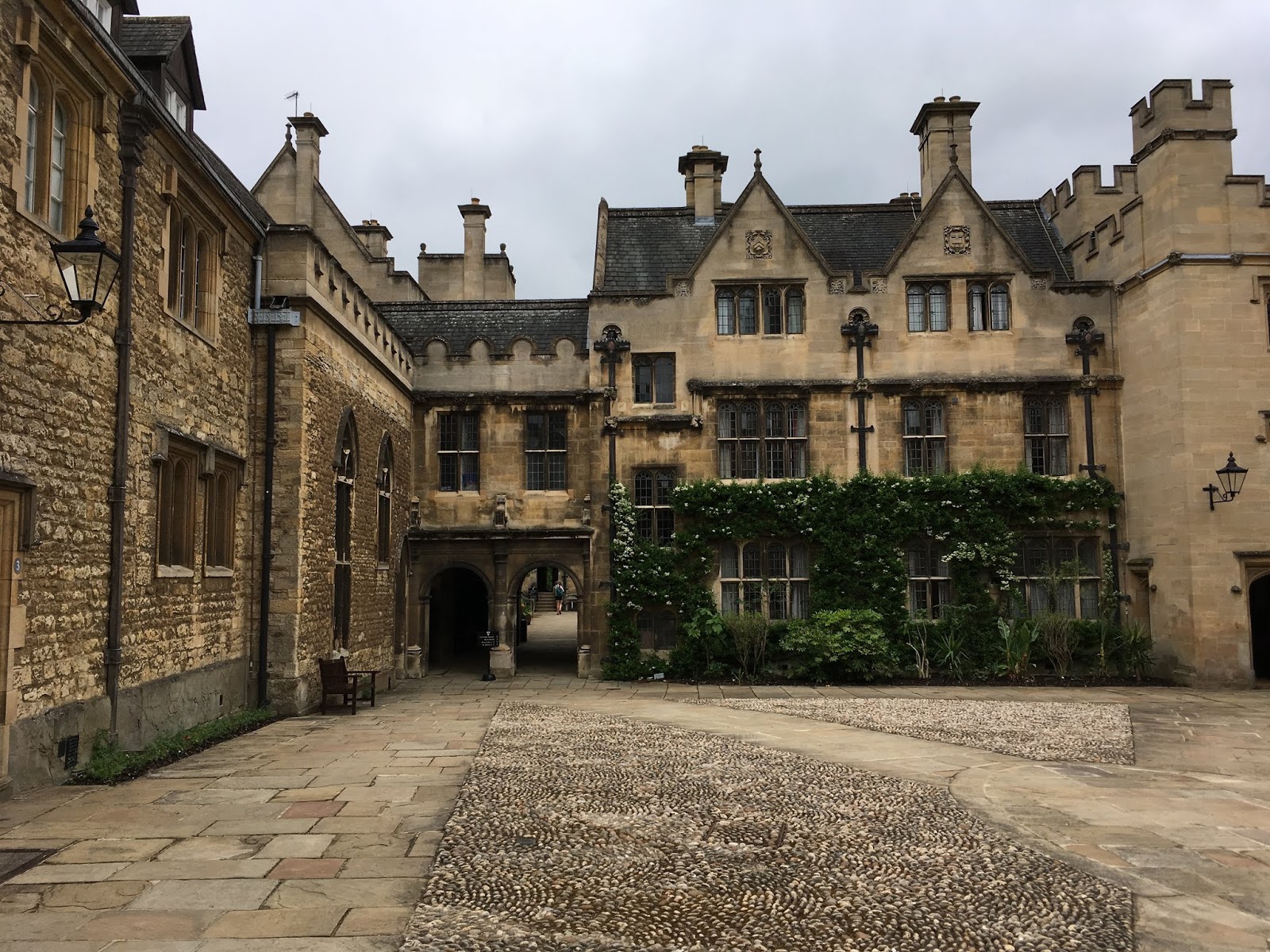
I was intrigued by this one word on a paving stone in Merton College.

All sorts of things came to mind.

Well, then.
Oh well.
Well...

All shall be well.

And then I asked the porter who informed me that the stone marks the location of the well so that should there be plumbing issues they would know exactly what part of the courtyard to tear up.

Ah, well.


Colors and neutrals coinciding.


The Divinity School.

Apparently collegiate croquet players are exempt from the mandate to 
PLEASE
KEEP
OFF THE 
GRASS
.
.
.


LONDON


Hello, Portobello Road.


Who knew a black house could be so charming and inviting?


The sign requests visitors to please keep to the path. I love the fact that the "path" is a mowed strip of lawn while the rest has been allowed to run wild. This is Kensington Palace Gardens, y'all. And in the middle of this grand spot we have a meadow.


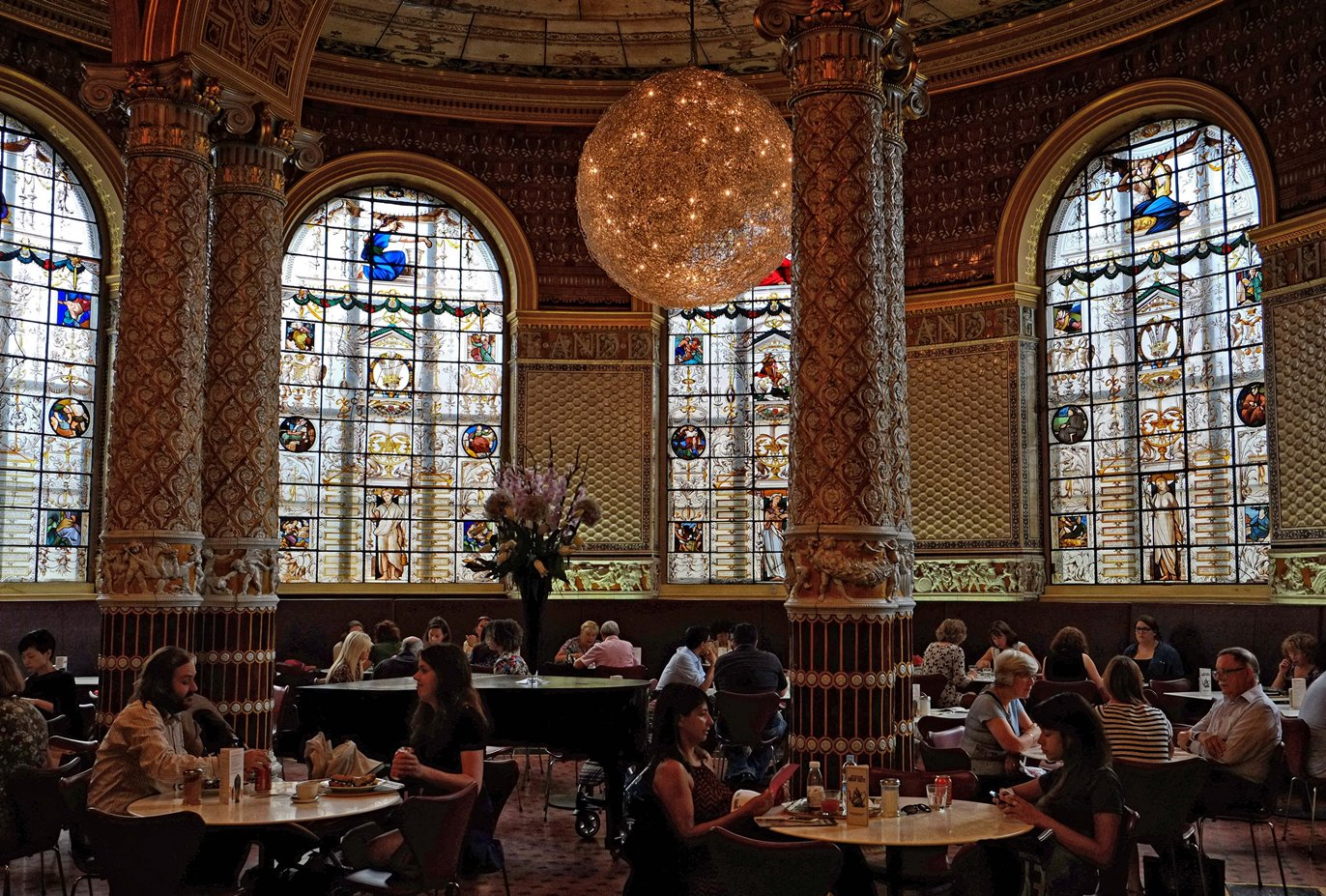
We went to the Victoria and Albert Museum solely to partake of their scones. Because the scones at the V&A are the best in the world. And the museum cafe's decor is a dazzling combination of Arts & Crafts style and modern snowball chandeliers. It's pretty much my favorite.


This takes the idea of gutting a building to a whole new level. I mean, the facade is left but EVERYTHING else is gone. Respect.

On the other side of the spectrum, we have some really futuristic stuff going on here... I would never have guessed that this was London. It feels more like Seoul. But it's just down the river from Westminster. Who knew?


We went to Motown the musical, which was super fun. The sign below was posted all over the theater and definitely gives a sense of the mood of the show:


I was definitely dancing in my seat. (How can you not dance in your seat to "I Want You Back" and "Ain't No Mountain High Enough"?) But no one asked me to moderate my enthusiasm. So maybe I wasn't enthusiastic enough?


The South Bank of the Thames:


Covent Garden:


There was a random magnet board on a wall in a secluded square in Covent Garden. So Mama and I collaborated on a poem.

dazzle away
shadow
with 
light

We were quite satisfied with ourselves.


A new way of seeing the Underground icon.


The whole time we were there, I kept thinking: I want to live here! 

Who knows? Maybe I will again. If I could make it back to Germany I can make it back to the UK. One can always dream.