Showing posts with label home. Show all posts

Thursday, June 25, 2020

My Soul Shelf: A Tribute

The professor that had the most impact on my faith and vocation is a dynamite American lit professor named Christina Bieber Lake. I could rave endlessly about how the way she teaches and lives shaped me, but that's not the purpose of this post. Suffice it to say that when I saw this scrawled on a bulletin board in a dorm my junior year I thought that the Bieber was referring to Dr. Bieber, as her students call her. 


Alas - most people are as untouched by her influence as I am untouched by the Justin Bieber fandom. Their loss. One of my best friends and I have declared that Dr. Bieber and Dr. Mazzarella (one of the other professors in the English department) are our spirit animals and we will be a dynamic duo like them when we grow up and achieve our professorial dreams. 

Anyway. Dr. Bieber wrote a book that just came out this month: The Flourishing Teacher: Vocational Renewal for a Sacred Profession. I preordered it, squealed when it arrived in the mail, and read it in four days. It's a mix of wit and wisdom - practical and spiritual - for the teaching life. Though, to be honest, I would give it to just about anybody because it's basically just a good perspective on life in general. I laughed and nodded and underlined and cried and wrote notes in the margins that only I or friends who actually took her classes would understand. 

That was the huge gift of this book - I got to see how Dr. Bieber approaches teaching very deliberately and that the impact that she had on me and my friends was not by chance. I got to marvel anew at the privilege I had of sitting under her as a college student - and of being able to learn from her again as a new teacher, since she is one of the main reasons I figured out I was supposed to teach in the first place.

One of the many life-giving tips Dr. Bieber gives in her book is to build what she calls a soul shelf - a shelf of the books that you can always count on to rejuvenate, inspire, and give your soul rest.

Being the good student that I am (and also being someone who never needs to be told twice to rearrange a bookshelf as a good pastime), I went and built my soul shelf this afternoon. It only took me about 10 minutes, because I know the books that speak to me like that - I just had to collect them on one shelf.  It makes me happy just looking at it. 

Dr. Bieber ordered her soul shelf according to three categories:

Beauty -"What makes me remember that my life here is a gift of immeasurable beauty?"

Simplicity - "What helps me recognize that it is possible to live in the present moment in peace and the fullness of joy?"

Love - "What inspires me to come out of myself and cultivate a healthy love for others?"

Now. These are lovely and very helpful categories. I fully intended to order this list according to them as a handy reference for anyone who stumbles across it. However. Most of the books on my soul shelf fall into at least two of them, and there are many that belong in all three categories.

So here they are. In an order that makes sense to me. Some of them are already on The Bookshelf, while others are new to me in the two years since I created that list. I'll add those to The Bookshelf soon.

BEAUTY * SIMPLICITY * LOVE

A Book of Luminous Things: An International Anthology of Poetry, edited by Czeslaw Milosz - 
I found this at a used bookstore in January and bought it because I loved the title, I know Milosz, and most of the poets were unfamiliar to me (highly unusual when I pick up a poetry anthology), and most of them did not originally write in English. This book is truly luminous. I read it from cover to cover, which is actually unusual for me when it comes to poetry anthologies. In case you're curious, and these names mean something to you, some poets included who I was previously familiar with are Denise Levertov, Mary Oliver, Walt Whitman, Raymond Carver, and Robert Frost.

Milosz says this in the introduction to one section:

Epiphany is an unveiling of reality. What in Greek was called epiphaneia meant the appearance, the arrival, of a divinity among mortals or its recognition under a familiar shape of man or woman. Epiphany thus interrupts the everyday flow of time and enters as one privileged moment when we intuitively grasp a deeper, more essential reality hidden in things or persons. 

A Thousand Mornings, by Mary Oliver 
 - This is the only volume of Oliver's poetry that I own (hopefully that will change soon), but it's a good one. Her poems are exquisite, humorous, and bracing by turns. I am always refreshed when I turn to them.

The Stream and the Sapphire, by Denise Levertov 
- I actually first encountered Levertov through Dr. Bieber, who gave me this slim little volume when I graduated. This is a collection of her poetry engaging with ideas of faith. I particularly love "Annunciation," which is too long to include here, and "Avowal":

As swimmers dare
to lie face to the sky
and water bears them,
as hawks rest upon air
and air sustains them,
so would I learn to attain
freefall, and float
into Creator Spirit's deep embrace,
knowing no effort earns that all-surrounding grace.

Come and Eat, by Bri McKoy - I wrote about this book in this post. Bri winsomely and with great joy makes the case that if we want to share the love of Jesus with the world, we need to start by inviting others to share meals at our tables.

"Too often I notice how I can become hardened by the seemingly insurmountable evil in this world. But here's the thing: we know who ultimately wins the battle. We know our Rescuer's name. He is not calling us to rescue anyone; he is calling us to pull out a chair and sit amongst the broken. He is the Rescuer. We are simply an extension of his great love and peace. And he calls us to continue stepping into brokenness and gives us the strength to face the unimaginable under the banner of his love. So we must show up."

Adorning the Dark, by Andrew Peterson - This book. It's a Christian creative manifesto. Peterson started the Rabbit Room, a collective of Christian creatives inspired by the Inklings and Wendell Berry, among others. I underlined and starred and annotated the heck out of this book.

"Righteousness means more than pious obedience; it means letting a strong, humble mercy mark your path, even when - especially when - you don't know where it is taking you. . .Your heart is so full it must be must be poured out. You see the world as a dark, messy place that needs rearranging, and with all that light shooting out of your pores your just the person to do it."

The Hiding Place, by Corrie Ten Boom – every Christian should read this at some point. As much the story of a family living faithfully in ordinary life as the story of how they handled the extraordinary circumstances of occupied Holland in WWII. 

“When He tells us to love our enemies He gives, along with the command, the love itself.” 

A Circle of Quiet, by Madeline L’Engle – lyrical memoir by the author of A Wrinkle in Time about faith, life, and creativity.

“An infinite question is often destroyed by finite answers...To define everything is to annihilate much that gives us laughter and joy.”

Quotidian Mysteries: Laundry, Liturgy, and Women’s Work by Kathleen Norris - very short, practically a pamphlet, on how important small, ordinary things are in developing the rhythms of life that give us space to walk with God. Dr. Bieber assigned it in the first class I took with her. 

“The ordinary activities I find most compatible with contemplation are walking, baking bread, and doing laundry. ” 

“My goal is to allow readers their own experience of whatever discovery I have made, so that it feels new to them, but also familiar, in that it is a piece with their own experience. It is a form of serious play.” 

One Thousand Gifts, by Ann Voskamp – beautifully crafted piece about gratitude, trust, faith, and living in the present. A long-time favorite of mine. 

“...the secret to joy is to keep seeking God where we doubt He is.” 

“A life contemplating the blessings of Christ becomes a life acting the love of Christ.”

Surprised by Oxford, by Carolyn Weber – riffing off Surprised by Joy, the author’s story of questioning and faith during her time as a masters’ student in Literature at Oxford University. Oozing with literary references and a delightful read. 

“He quickened his stride: 'The truth is in the paradox, Miss Drake. Anything not done in submission to God, anything not done to the glory of God, is doomed to failure, frailty, and futility. This is the unholy trinity we humans fear most. And we should, for we entertain it all the time at the pain and expense of not knowing the real one.” 

The Chronicles of Narnia
, by C.S. Lewis - beautiful, funny, poignant, and quick to read, these books provide better imaginative and intuitively graspable illustrations of the life of faith than a lot of theology I've read. (Which is why they so often crop up in sermon illustrations.) And they are simply good stories. The world is a different place with the Pevensie children and the people of Narnia in it. 

The Lord of the Rings, by J.R.R. Tolkien - I reread this trilogy every few years, and it gets better every time. Tolkien creates a world where evil is so palpable and powerful that there is only the slightest thread of irrational hope that good will win. The journey of the members of the unlikely fellowship to overcome evil and restore good is moving, funny, imaginative, and profound. It is a reminder that courage and beauty and hope and friendship can be found in the most unlikely of places - even when the forces of evil seem insurmountable. 

"There's some good in this world, Mr. Frodo, and it's worth fighting for."

(To be completely honest, I'm not 100% sure if the above quote is from the book or the movie, but it's a great quote all the same.)

The Tale of Desperaux, by Kate DiCamello – I love this book about a very small mouse with very large ears, a kingdom in desperate need of soup, and a princess named Pea. Is it choice or lineage that makes someone what they are?

“Once upon a time," he said out loud to the darkness. He said these words because they were the best, the most powerful words that he knew and just the saying of them comforted him.” 

Les Miserables, by Victor Hugo – this book. Detective story, redemption story, love story, revolution story, with a good dose of random background information on the battle of Waterloo, the sewers of Paris, street slang, and obscure convents thrown in. Stunning on every level. 

“A garden to walk in and immensity to dream in--what more could he ask? A few flowers at his feet and above him the stars.” 

To Kill a Mockingbird, by Harper Lee – a classic for a reason. It’s so much more than a story of racial injustice in the Jim Crowe South. It’s a story about childhood and growing up, family, community, and walking around in someone else’s shoes. And who doesn’t love Scout Finch?

“Until I feared I would lose it, I never loved to read. One does not love breathing.”

Till We Have Faces, by C.S. Lewis – widely considered to be Lewis' best fictional work, this one blows my mind every time I read it. Reimagining of the myth of Cupid and Psyche, with profound things to say about love, integrity, the longing for home, and knowing oneself.

“The sweetest thing in all my life has been the longing — to reach the Mountain, to find the place where all the beauty came from — my country, the place where I ought to have been born. Do you think it all meant nothing, all the longing? The longing for home? For indeed it now feels not like going, but like going back.” 

Jayber Crow, by Wendell Berry - This novel is the ruminations of a man who didn't go many places or do much, but who led a whole, good life. It's a book about inward change even when externals haven't changed much. It's like the river which plays a prominent role in the story: it doesn't go anywhere, but it's always changing. It's a book about calling, about valuing what is, about quiet doubts and quiet faith, with a lot of dry humor thrown in. It's about letting go of the need to "make something of yourself."

"You have been given questions to which you cannot be given answers. You will have to live them out - perhaps a little at a time."

"Faith is not necessarily, or not soon, a resting place. Faith puts you out on a wide river in a little boat, in the fog, in the dark. Even a man of faith knows that (as Burley Coulter used to say) we've all got to go through enough to kill us."

Gilead, by Marilynne Robinson – a stunningly beautiful book. One of my top 5 favorite books ever. A letter from a dying father to his young son, it’s a meditation on grace, fathers and sons, forgiveness, faith, and the beauty of this earthly life. People tend to either absolutely love it (that’s me) or be bored to tears because not a ton happens. I love the sequel, Home, too (it’s a kind of prodigal son retelling), but I may just be partial because it touches on themes near and dear to me. 

“This is an interesting planet. It deserves all the attention you can give it.

The Elegance of a Hedgehog, by Muriel Barbery – pensive, funny, mildly crass and decidedly European book about a concierge in Paris who is actually a brilliant autodidact. A treasury of small and beautiful things. Originally written in French.

“When tea becomes ritual, it takes its place at the heart of our ability to see greatness in small things. Where is beauty to be found? In great things that, like everything else, are doomed to die, or in small things that aspire to nothing, yet know how to set a jewel of infinity in a single moment?” 

Little, Big, by John Crowley – I read this for a Christianity and Fantasy class in college, and I’m not sure whether I would have fallen in love with it as much as I did if I hadn’t had the guidance of a fabulous professor. That said, the poetry of the dense prose, the multigenerational narrative, the themes of faith, doubt, love, longing, home, and narrative make this a fantasy I’m confident I’ll return to throughout the years. Be alert to skip some bedroom scenes.

“The further in you go, the bigger it gets.”

East of Eden, by John Steinbeck – extremely dark at times but also at times exquisite, this book is well worth the 600 pages. Set in California around the turn of the 20th century, it’s a multi-generational story about individual choice, the consequences of familial love and lack thereof, and asking questions about what determines someone’s character. I love this book for the secondary characters. Like Les Mis, exceptionally well-done on every level. Lyrical description, powerful exploration of themes, excellent characterization. 


“I believe that there is one story in the world, and only one. . . . Humans are caught—in their lives, in their thoughts, in their hungers and ambitions, in their avarice and cruelty, and in their kindness and generosity too—in a net of good and evil. . . . There is no other story. A man, after he has brushed off the dust and chips of his life, will have left only the hard, clean questions: Was it good or was it evil? Have I done well—or ill?”

Monday, May 11, 2020

a life in food


In her book Come and Eat: A Celebration of Love and Grace Around the Everyday Table, Bri McKoy makes a powerful and winsome case that if we want to share the love of Jesus with the world, we need to start by sharing meals at our table.

I have underlined and starred and hearted half the book. Many paragraphs have this annotation: "YES! So thankful to have learned this from Mom." I think this book is going to be a kind of handbook for me as I work through how to do life together around the proverbial table - the place where we come together and nourish our bodies with delicious food and build a community that nourishes our souls.

Somewhere in the book - I can't find the exact spot right now amidst the multitude of marked-up passages - Bri makes the claim that each of us can think of a meal that was pivotal to our lives.

That got me thinking. To be perfectly honest, I cannot yet identify a single meal that changed or defined the trajectory of my life. And yet - and yet -

One thing that was very important to my parents in my childhood was that we shared regular meals together. As homeschooled kids, Charlie and I were often left to our own devices for lunch, but nearly every evening of my childhood we gathered around table and shared a family meal. Many of those meals are ones that Mom - and later Mom and I - prepared in 30 minutes or less. Many were at our favorite local restaurant. Many were in the places we travelled. Most of my formative memories are in some way linked to food. I don't remember much about Krakow, but I will always remember the mouth-watering pirogies we ate there. I have many memories in Italy, but one of the most vivid is when the waiters at a restaurant on the coast all vanished to jump into fishing boats because a school of fish was swimming by and they needed fresh seafood.

While there is no one meal that fundamentally changed my life, the meals that I shared with my family were formative in ways that I can only begin to name. They created a space of security, a space for laughter, a space for hard conversations, a network of memories that is strong and steadfast. If I were asked to, I truly think that I could tell the story of my life as a story of meals. Here's a start.

I am six. Hair in a "truly" - the half-up hairdo that my family named for Truly Scrumptious. I'm all dressed up because I just "graduated" from kindergarten. We are celebrating at the Rose Garden Cafe.

I am eight. It is the Fourth of July. Pop, Charlie, and I have already participated in the parade. Now it's time for lunch. Perry's BBQ, with all the requisite sides: green beans, mac and cheese, hush puppies, coleslaw, collard greens. We lick our fingers and eat watermelon for dessert.

I am ten. A loaf from Panera bread, sun-dried tomatoes and olives from big Sams Club jars, cheese, and grapes are arranged tastefully on our coffee table. We are having a "European picnic" - a frequent meal in our home in Virginia as we practiced for a hoped-for return to life in Europe.


I am eleven. We just moved back to Germany, Dad is deployed, and Mom, Charlie, Nana and I are in Paris. We get crepes from a stand behind Notre Dame - a stand that became a standby for meals on the go in the city of lights.

I am twelve. We have already had gelato twice, but we've hiked for hours among Italian fishing villages. When we reach the last village and Charlie and I beg for one last scoop, Dad doesn't say no.

I am thirteen. My fingers and toes and nose are freezing but my throat is burning with too-hot Nurnberg bratwurst chased down by Kindergluhwein - the alcohol-free version of mulled wine that is a staple at German Christmas markets.

I am fourteen. We take the train to Venice with a friend who lives an hour from the floating city. We ignore all the tourist destinations (which we had seen on a previous visit). Instead, Reba takes us to a corner grocery stores patronized by locals (imagine being a local in Venice). We purchase just-ripe nectarines, a loaf of long white bread, and a cheese that is kin to provolone. We sit on the steps by a canal and make rustic sandwiches. The nectarine juice drips down our fingers.

I am fifteen. We visit London for the umpteenth time, and beeline for our favorite fast food place - Pret a Manger, which still has the best carrot cake I have ever eaten. Not to mention their prawn arugula avocado sandwiches. We take our loot to the fountains near the lions on Trafalgar square.

I am fifteen. We walk to Da Silvano, the local pizza place where Isabelle, the waitress, brings out our drinks before she takes our order - we are regulars. Another night we walk to the Greek restaurant that has the most delicious gyros salad you have ever tasted. One time my parents were on a date there, and the owner pointedly ignored Dad waving for the bill, because she had decided their date hadn't lasted long enough. Which would have been fine, except they were then late to Bible study.

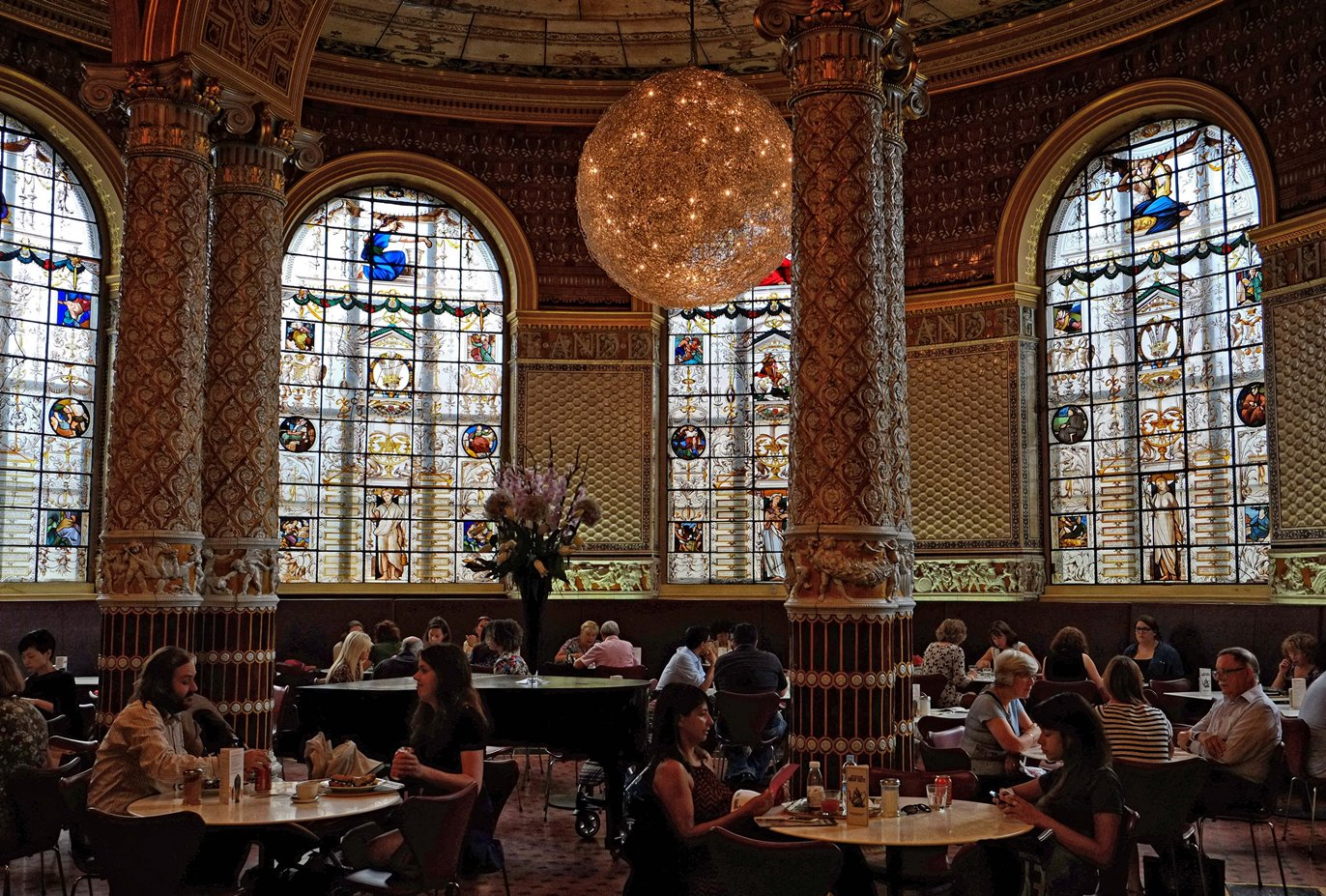
I am seventeen. In London again, we make a pilgrimage to the cafe in the Victoria & Albert Museum. Decorated by William Morris, this cafe has the best scones and clotted cream our family has ever tasted.

I am eighteen. I have just graduated from high school, and my grandparents borrow a pontoon boat for an afternoon on the lake. My cousin Hannah makes to-die-for strawberry-filled cupcakes. I'm not a cupcake person in generally, but my mouth still waters at the memory of these.

I am nineteen. It's floor night on the college dorm, and we pass around a pan of pizookie, taking ritual spoonfuls straight from the pan. Sure, it's cold season, but who is going to pass up just-barely-baked chocolate chip cookie with ice cream on top?

I am twenty. Mom and Dad graciously take me along to Charleston on their anniversary trip. We savor the best shrimp & grits in the history of Southern cooking.

I am twenty-one. I fill my semester abroad with oatcakes and cheese and scones and clotted cream on study dates with friends. Occasionally I splurge on a mouth-watering, artery-clogging full English breakfast - complete with beans and grilled tomatoes.

I am twenty-two. I fling my tiny college kitchen open to whoever wants to come - the freshman who is a kindred spirit, the surrogate grandparents who bring over veggies from their garden, the core group of friends who have walked through all four years of college by my side. We laugh and we cry and we grow and we learn from one another.

I am twenty-three, living in Munich after college. A girl from church - a fellow expat - has decided we are going to be friends. She invites me over for countless lunches of scrambled eggs and fried potatoes - comfort food. Over those countless lunches, we become fast friends.

I am twenty-four. Mom, Dad, Nana and I are in a tiny village clinging to a hill in Galilee - Zafed. There we have the freshest-you-could-possibly-imagine falafel, fingers chilly in the cold rain, bellies warmed by the freshly fried food.

I am twenty-five. On Tuesdays, my church Community Group has themed potlucks. Asian food, childhood favorites, vegetarian night, appetizer night. Each dish comes with a story that we share as we do life together.

I have a list of formative/memorable meals that spans five pages of a legal pad - and that was only the ones that sprang to mind effortlessly. There are so many more.

I have no idea how the rest of my life will pan out, but one thing I can confidently claim is that food - good food, shared with friends, family, and strangers - is going to always be a key part of my life.

Mom and Dad, thank you. Thank you for building our family around the table. Thank you for recognizing and cultivating the richness of experiences built around food. Thank you for giving me my love of good food and good conversation and safe and holy spaces. What a legacy.


P.S. Mom, as I write this, I'm listening to the French Kiss soundtrack. Nothing says "dinner music" like that album.

Wednesday, April 29, 2020

A Letter to Wheaton's Class of 2020

Wheaton is much on my heart these days. It's Wheaton Gives day - and I gave in honor of Julius Scott, a professor I never met but whose presence at Wheaton indelibly impacted my time there decades later. Several days ago, I got an email asking recent grads to send a note of encouragement for the class of 2020. I sat and typed this out on my phone with my whole heart. 


Dear Wheaton Senior,

The first time I cried during the pandemic was for you. I graduated just three years ago, and I grieve with you for the loss of your final quad at Wheaton.

But I have also rejoiced to see you responding with hope and resilience. The insta account @overheardatwheaton brings me so much joy. I’ve talked to some of you about the unexpected fruitfulness of online discussion forums, even in the midst of frustrations regarding zoom classes.

You didn’t leave Wheaton as you expected to. But you do leave prepared. You spent nearly four years at an institution dedicated to shaping you to go out into this broken world with great hope as you live for Christ and His Kingdom. I believe that even this unexpected end is for the purpose of preparing you to live with that call shaping your life.

Your dreams may be crumbling, or taking new forms. God has dreams for you, too, and the pandemic is no glitch in His plans. He is with you. He goes before you to guide you, behind you to protect you, beneath you to sustain you, and beside you to befriend you. Do not be afraid. The blessing of God is upon you. Although you are sad, do not be afraid. Go in peace - the peace that passes understanding, that is the shelter of those whose minds are fixed on the Lord, that is the gift you carry as you endure Coronavirus.

So stay strong as you finish up those zoom class sessions. Relearn your class song and sing it with gusto. Teach it to the family members you are quarantining with. Look through the years of photos and quotes from quote walls and send them to the friends you looked forward to celebrating your achievement with. Remember, and grieve, and laugh, and celebrate. During my last quad at Wheaton I found that laughter and tears are strangely suited to be beautiful companions. But even when it doesn’t feel beautiful - when it feels ugly and wrong and unfair - feel those emotions and bring them to the God who brought you to Wheaton in His own good time and has taken you from Wheaton according to His timing, not yours.

He meets you here - in online learning, in uncertainty for the future, in loose ends left untied - and He holds all of you with care and compassion and grace.

Be blessed, and know you are beloved.

Grace,
Kate 


Thursday, July 25, 2019

hummingbirds and toads

There are cicadas whirring outside my window. It is 9:30 pm and it's already dark outside. It was 85 degrees Fahrenheit today and people were sighing at how nice and cool it is.

I'm on day three in my new stomping grounds in the Raleigh, NC area. The last two months have taken me from Munich to Austria to the Lakes District in England to the West Highland Way in Scotland to Raleigh, North Carolina. It's been a wonderful whirlwind.

I'm not going to lie: transitions are hard and culture shock is real (you can see my friend Angela's take on that here) and there have been tears. This morning, in fact.

But there have also been many small, good things today that remind me that this is where I want to be.

Here are some of them.

~ a tiny toad the size of my thumbnail on the sidewalk
~ hummingbirds zipping in and out of the garden
~ a bunny rabbit meandering through the yard
~ cicadas so loud I hear them through my closed window every night
~ a pool with water that is pleasantly tepid, not freezing
~ gracious people
~ magnolia blossoms
~ crepe myrtles
~ white pine trees
~ a dryer so my laundry is finished after two hours total
~ garlic bread
~ iced tea
~ a screened-in porch

In the middle of so much newness, little things like these go a long way toward helping me keep my chin up. As does the audiobook of Charlotte's Web narrated by E. B. White himself. Just saying.

Thursday, May 16, 2019

The Art of Leaving Well

One thing I've learned through many moves over the years is that leaving well is an art form, not a formula.

It would be easier if it were a formula: I could make a list, check off all the boxes, and tie up all the loose ends before moving on.

But that's not how life works. Uprooting is a messy, unpredictable business. Just as I successfully pull up one tie to a place, I inadvertently establish another. Somehow I always manage to be putting down new roots until the actual moment of being transplanted.

I'm moving away from Munich in less than a month, and it is really tempting to check out now. But I’m still here. If I’m called to bloom where I’m planted, that means I’m called to bloom here until the day I go. 

So even while I set up final visits with friends, I allow myself to spend time with new acquaintances. I initiate a four-week Bible study with a teenager from church. I invite a couple of kids over for a tea party.

I visit familiar haunts for the last time while still discovering new, delightful places.

Even while I'm preparing to leave, I still live here. There are still things for me to do here.

None of this means living in denial. Closure is important. But the truth is that there will always be loose ends. There will always be unfinished conversations and unexplored possibilities and things on the to-do list that never got done. People that I wish I’d sought out over the last two years that it’s now time to say goodbye to. It’s enough to make me crazy. 

In the weeks before I graduated from college, I was under immense pressure and immense blessing. I was preemptively grieving the loss of a community that was precious to me while daily receiving all the riches that community had to offer. I did not know how to process it all, and I was afraid that I would leave important things undone - that somehow I would miss something crucial and have no chance to rectify my mistake.

During that time the Lord gave me a word through a friend: "Rest easy. I'll take care of the loose ends. Fear not. Trust Me."

While this transition is not nearly as devastating as that one was, it is good for me to remember the assurance God gave me in the midst of it.

It’s a reminder that the work I’ve been doing here in relationships and community isn’t actually my work: it’s the Lord’s work. And it is being accomplished in His timing. If it feels unfinished to me, that’s ok, because I’m not the one responsible to finish it - He is.  

In the meantime, I write myself reminders, give myself space to grieve and to rejoice, hang out with friends, and practice the art of leaving well.

Sunday, April 21, 2019

Poetry Corner | Two Easter Poems

I couldn't choose which of these to share, so here are both. 

Ikon: The Harrowing of Hell
by Denise Levertov

Down through the tomb's inward arch
He has shouldered out into Limbo
to gather them, dazed, from dreamless slumber:
the merciful dead, the prophets,
the innocents just His own age and those
unnumbered others waiting here
unaware, in an endless void He is ending
now, stooping to tug at their hands,
to pull them from their sarcophagi,
dazzled, almost unwilling. Didmas,
neighbor in death, Golgotha dust
still streaked on the dried sweat of his body
no one had washed and anointed, is here,
for sequence is not known in Limbo;
the promise, given from cross to cross
at noon, arches beyond sunset and dawn.
All these He will swiftly lead
to the Paradise road: they are safe.
That done, there must take place that struggle
no human presumes to picture:
living, dying, descending to rescue the just
from shadow, were lesser travails
than this: to break
through earth and stone of the faithless world
back to the cold sepulchre, tearstained
stifling shroud; to break from them
back into breath and heartbeat, and walk
the world again, closed into days and weeks again,
wounds of His anguish open, and Spirit
streaming through every cell of flesh
so that if mortal sight could bear
to perceive it, it would be seen
His mortal flesh was lit from within, now,
and aching for home. He must return,
first, in Divine patience, and know
hunger again, and give
to humble friends the joy
of giving Him food—fish and a honeycomb.


***

***

***

Easter Day
by Christina Rosetti

Words cannot utter 
Christ His returning: 
Mankind, keep jubilee, 
Strip off your mourning, 
Crown you with garlands, 
Set your lamps burning. 

Speech is left speechless; 
Set you to singing, 
Fling your hearts open wide, 
Set your bells ringing: 
Christ the Chief Reaper 
Comes, His sheaf bringing. 

Earth wakes her song-birds, 
Puts on her flowers, 
Leads out her lambkins, 
Builds up her bowers: 
This is man's spousal day, 
Christ's day and ours.

Monday, April 15, 2019

finding home


The soul finds its own home if it ever has a home at all. ~Marilynne Robinson, Home, 282

Dear Katie,

On Sunday after church, you asked me if I ever wondered where home is. You are bright and outgoing and wistful and twelve years old. 

The question caught me off guard, and I answered with my knee-jerk reaction: Yes. I do wonder that, often. And as I wonder, sometimes the only thing that enables me to keep moving forward is the promise that our citizenship – our ultimate home – is in heaven. It seems abstract, but it is more concrete than any other answer I can offer in the space of a brief interaction in the church foyer.

But I’ve kept thinking about it. 

I've lived in nine different cities. Not counting the three places my parents have lived since I left for college. Two continents. Three countries. Zip codes that all run together in my head so that I always have to double-check before writing my return address. 

I'm moving to my tenth city in two months. 

When do I not wonder where home is?

For both of us, home is not a particular house on a particular street in a particular city, state, and country. And there’s a certain sadness to that – a sense of loss that I hear in the way you ask the question. When you ask where home is, I wonder, What would it be like to have one home?

Home is cardboard boxes and moving crates and knowing that this place is only temporary - and I hate that. 

And yet. And yet.

Home is every place I have unpacked those boxes. Would I really want to give any of those places up for the boon of just having one home?

I have a home that is far bigger than one house in one city. I have not one home, but many. I look for hints of home wherever I go, and often I find it in unexpected places. 

I discover a piece of home every time I walk into an art gallery. Also every time I walk into a bookstore.

Home is James Taylor's album "October Road" on repeat from July through November. And my mom's collection of Christmas music. And Handel's "Messiah."

Home is a dorm room filled with more people than is entirely comfortable - a jumble of coats and books and mugs of steaming tea and rich conversation - or silence. 

Home is wherever my parents live. 

Home is Orion in the clear winter sky. 

Home is gathering friends together to cook and laugh and visit.

Home is humid days on a screened-in-porch in North Carolina, swinging in a hammock, listening to the creek.  

Airports are home. And train stations. Any place where people occupy liminal space - in transition from one place to another. 

Home is the sound of the Amsel - the German blackbird with an orange beak that has the most beautiful song in the world. It is also the sound of cicadas whirring in the North Carolina heat. 

Home is the community of believers learning what it means to be pilgrims to the city of God. Sometimes we speak German as we walk through life together. Sometimes English. The language doesn’t matter as much as we sometimes think it does. 

Home is the quilts my grandmother made.

Home is a kitchen in a church basement.

Home is whatever hotel I'm spending the night in. 

Home is the collection of postcards and posters and photos and paintings that I tape to the wall and then take down again when it's time to go. 

Home is a gift that I often find when I least expect it. 

Home the way we want it doesn't exist. There is no place in the world where all the people who are precious to us gather to do life together. And even if there were, a lot of the people we love don't speak the same language. There is no one house in the world that holds all the smells we associate with home and holds all our memories. There is no place in the world that can possibly satisfy the yearning for a place where we are fully known, fully at rest, where all is truly, deeply, profoundly, well

That yearning is only fulfilled when Christ's Kingdom is made manifest. And that is why I cling tight to Paul's proclamation that our citizenship is in heaven: because it gives me hope that one day the yearning for home will actually be fulfilled. Though the ache seems to last forever, it will only last a lifetime. A lifetime seems long when you're in the middle of it. Especially when you're twelve. Or even twenty-four. But then there's forever. Forever at Home. What a weight of glory. 

For now, we get to carry around that yearning as we live the live of nomads. And we carry around more than that longing - we get to carry some of the things that make a place a home. My mom puts the Mary Engelbreit "bloom where you're planted" magnet on yet another fridge. I turn on the music that holds sustaining memories. We cook food that nourishes our bodies and reminds us of other meals around other kitchen tables. We schedule FaceTime calls and send text messages and write letters. 

We refuse to be defeated by the reality of how temporary this all is. We choose to put down roots even though we know that when it's time to move on the uprooting is agonizing. Because as long as we are willing to put down roots, we have access to a foretaste of home. As long as we look for them, we will find bits of home that we can carry with us wherever we go.
  
Grace,
Kate

Tuesday, September 4, 2018

my at-home place


“Ulm ist meine Heimat, aber München ist mein Zuhause.”

Something clicked in my head when an acquaintance from church said that. The sentence is difficult to translate, since it involves two words for home that mean slightly different things.

Loosely translated, it means, “Ulm is my hometown, but Munich is my at-home place.”

In August, I spent a week at a retreat for young people at my church in Munich. I realized during that time that in deciding to stay in Munich for a second year, I have chosen to acknowledge Munich as my Zuhause - my at-home place. The place where I’m home to friends and family and the people of God. It’s not Wheaton anymore. It’s Munich. That is a bizarre realization. 

I could have left relatively easily at the end of this past year. Sure, I chose to put down roots in Bavaria’s capital, but when all’s said and done, I was only there for ten months. It wouldn’t have hurt too much to leave. 

But after another year there - another year of putting down roots and building relationships and blooming where I’m planted - it’s going to be hard to leave my at-home place. As aware as I am of that, I have no doubt that it’s worth it to stay. Munich is where I am supposed to be during this season, and I rejoice to be there.

So I’ve added a new term and a new place to my ongoing preoccupation with the concept of home. 

My True Home is heaven, and any other stopping spot in this life is a pilgrim’s haven. 

My homeland is America. 

My home state: North Carolina.

My home town: wherever my parents live.

My at-home place? For now, it’s Munich. And that’s a really good thing. 

Thursday, May 31, 2018

Things I Learned This Month | May 2018


It's time to wrap up the month of May with a list of some of the things I learned this month!

1. I really, really love the UK. 
Granted, I knew this already, but getting to spend Memorial Day weekend in London and Oxford reminded me how much of an Anglophile I really am. I was so happy to be back that I jumped up and down. All weekend.

2. It is possible to die as a direct result of too much studying.
I spent a day showing my parents around Oxford, and we took a tour of the Bodleian Library. Which was so much fun, since I spent tons of time studying there but had never taken a tour. Evidently, fire has never been allowed in the library. Understandable. But this means that until the invention of electricity, there was no heat in the building. Which meant that if it was freezing outside, it was freezing inside. At least two students in the history of the library died of hypothermia.

3. In spite of this fact, I really miss studying.
Evidence of my eccentricity: while I proctored a test earlier this month, I found myself reminiscing fondly over my favorite exams in college. Yes, I had favorite exams. Dr. Bieber's, to be precise. Missing exams is a surefire indicator that I'm a student at the core. Whether I actually pursue further schooling or just do independent work, I want to be learning for the rest of my life.


4. Pea cake with lemon buttercream icing is surprisingly good.
I saw this in the Victoria and Albert Museum cafe when we were in London. Since it is an unalterable family tradition to get tea and scones in the V&A (because they are hands down the best scones in England), I didn't get the pea & lemon cake, but I made a mental note to try it at home. The day after getting back, I did, and it's surprisingly yummy. (I used this recipe, if you're interested. The icing was too sweet, but that's tweakable.)

5. I prefer the 1984 NIV Study Bible to the ESV Study Bible. 
The notes in both are good, but the NIV Study Bible has way more cross references, which I find really helpful.

6. Third Culture Kids: Growing Up Among Worlds, is just what I needed to be reading at this point in life. 
I'm reasonably familiar with the TCK experience, being one myself. I also think that I'm a reasonably well-adjusted TCK. That said, this book has been hugely cathartic as I realize that many of the things I think about and deal with on a daily basis are common to third culture kids throughout the world. For example, the feeling of being as at home in an airport as anywhere else in the world. Or wrestling with how to answer the question, "Where are you from?" and realizing that this is a different question than "Where's home?" Or having very strong loyalty to a sponsoring organization (for me, the army) even after you're no longer living with the parents who are actually members of the organization. I'm going to be thinking about this book for a long time.

7. My father is the baby whisperer. 
I'd heard legends, but never seen him in action. My parents and I watched a 6-month-old for an evening, and Dad was amazing. Mom and I enjoyed holding the baby, feeding the baby, and playing with the baby, but the instant she started fussing we were so out of our league and Dad took over. Within moments she would be chuckling and giggling. Every. Single. Time. Whatever that gift is, it's innate, not learned, and I don't have it. I can keep a baby safe, but I definitely can't guarantee a happy baby. I'm in awe.

Monday, May 7, 2018

Mama's wisdom | bloom where you're planted


Long before the boxes are unpacked, my mom puts a magnet on the fridge.

“Bloom where you’re planted.”

In a life of constant transition, frequently uprooting from a now-familiar place to move once again to new cities, states, and even countries, it’s a blessed and much-needed reminder.

Over the years the phrase sinks into my bones.

I add my own to it: an index card with a Jim Elliot quote in blue letters:

“Wherever you are, be all there.”

Over the years, I build up a collection of quotes, Bible verses, fragments of sayings circling the idea of being present, making a home, putting down roots while knowing another change is just around the corner. Clinging to a heavenly home while making a haven of each place of sojourning.

There are two ways to handle the constant moving.

One is to remain distant, getting by on superficial relationships and minimal involvement. You avoid making ties to people and places in order to minimize the pain of parting. Don’t nest, because soon enough you’re going to have to pack it all up again.

The other option is to choose to put down roots. It’s a deliberate choice, made because you know the richness and joy of a life rooted in a particular place and a particular community. But you count the cost every transition. Uprooting is exhausting, and you leave a part of your heart behind you. Every. Single. Time.


I’m a roots person.

As I ran through a park in Munich today, reveling in the uncontainable outburst of spring, I realized why.

A plant can’t bloom if it doesn’t have roots.

I have to put down roots, however temporarily, or part of me will wither. I would much rather have a rich life with bittersweet partings than close myself off from pain and joy alike.


This is a common theme for me, and it’s at the forefront of my thoughts right now.

It’s not just the visible presence of spring and new growth that has me pondering transient rootedness.

A year ago today, I graduated from college. That particular uprooting was agony.

Now I’m waiting to hear if I get to stay in Munich for another year or if something else is in store.

When I moved here eight months ago, I assumed I’d be here just shy of a year. Even so, I became a member of a church, joined a choir, hung pictures on my wall. I made the space a spiritual and physical home, not simply a place to spend the night.


During the times when I got restless and lonely and frustrated with the challenges of being in a new job in a new city in a foreign country, I challenged myself be more present here instead of withdrawing and hunkering down until my time was done.

Now I have two possibilities: stay another year and continue to deepen the roots I have here or transplant again come July.

Whether now or later, inevitably I will pack up and leave Munich. I’ll move to another place. And one of the first things I do there will be to unpack my own reminders. Reminders to bloom where I’m planted, to be all there in spite of – and because of – the knowledge that eventually I’ll move on again.