Showing posts with label fellowship. Show all posts

Sunday, February 7, 2021

rational and loving conversations: an approach to disagreement

{Painting from Glimpse Art}

"There have been other things you have posted over the last few years that I took violent exception to but I didn't say anything about. And I probably won't again." 

When I read this Instagram DM from a dear longtime friend, my first emotion was sadness. Not exactly sadness that we disagree - sadness for missed opportunities to gain a new perspective and challenge my own thinking. 

These came in the middle of a long and somewhat heated exchange about something I'd reposted. The specifics aren't important for the purposes of this post. Suffice it to say that my friend challenged the logic and presuppositions of what I'd posted and pointed out implications that I hadn't thought about. I'm so grateful for her willingness to engage with me. 

While the broad brushstrokes of my opinion haven't changed, as a result of our conversation, I have more questions that I want to pursue answers to, a more nuanced understanding of the complexity of the issue, and a healthy, concrete example of my own fallibility in inadvertently communicating things that I didn't mean to. 

If you know me well, you probably know that I tend to live in a world of big ideas, literature, and philosophical ideas. Current events? Not my thing. At all. Too emotional. Too divisive. And, frankly, way too time-consuming and overwhelming for me to keep up with. Plus, in my mind, current events are things of the moment, while my beloved books help me tap into conversations that have been ongoing for centuries.

But I'd have to be a special kind of ostrich to have kept my head in the sand during the Year of Our Lord 2020.  

As I've begun to educate myself on a lot of issues and begun to develop my understanding of them, I initially limited conversations to close friends and immediate family members who I could expect to have a moderately similar perspective to my own. It was a safe space to process, and the kinds of issues that I've been processing can be highly emotional and divisive, so I wanted to play it safe. 

But then I was convicted. As I've watched the polarization of media and politics spiral out of control, I and many of my friends and colleagues have bemoaned the lack of healthy civil discourse in our country. Why can't we have rational and loving conversations about divisive issues and seek at a minimum to understand the other side, even if we can't reach an agreement?

Then I realized that if I want things to change, I have to start seeking out those kinds of conversations. 

I realized that my effort to avoid these sorts of conversations is, in many cases, much more telling of my failures than the failures of those who disagree with me. When I imagined opening conversations with specific people, my gut reactions were "I know what they have to say is going to make me so angry" and "I don't know nearly enough about this to defend my opinions to someone who disagrees with me." Guess what? Both of those things are my problem: I need to work through not feeling personally affronted when my ideas are challenged, and I need to have the wherewithal to put in the legwork to actually know what I'm talking about. I also need to be ok to admit when I don't have an answer and need to revisit the conversation later, after I've done more research.

So, slowly, I've started engaging in conversations with people who I value highly and also disagree with on some pretty key issues. Sometimes I initiate the conversation. Other times, a conversation lands in my lap (or, rather, an email lands in my inbox), and I have to formulate a response to an issue that I didn't really intend to address. 

My primary goal in these conversations is not to win the other person over to my opinion (though of course it would make me happy if that eventually happens). Rather, it is to learn to understand their perspective and, hopefully, give them a gracious and well-articulated defense of my ideas so that they can also understand my perspective. Sometimes one (or both) of us end up with a slightly different perspective than we started with. Always, I want them to walk away knowing how much I love them, and that however big a disagreement might seem, it's small potatoes compared to how much I value the relationship.

I'm new at this. I've made mistakes. And that's scary, because I really like to be right. But more than that, I really like my relationships to be in a comfortable place, and these conversations are not comfortable. But they are ultimately much more productive than just skating around uncomfortable issues. 

This summer, Bri McKoy was talking about her own learning process in starting to speak up about some things she thinks are important but that can be divisive. She admitted that she felt like a beginner and that that's intimidating, because beginners make mistakes. She's a recipe blogger and cookbook author, and she compared the experience to her early forays into cooking. She forgot to salt her chicken SO MANY TIMES that when she finally remembered to salt her chicken, she felt like a huge success and posted the recipe on her blog. Now, she says, she would never recommend that recipe. But then, for baby cook Bri, it was a really big deal. And she could not have become the excellent cook she is today without being a beginner in the kitchen and making all sorts of beginner mistakes like not salting your meat. 

The moral of her story was that if we want to learn something challenging, the ONLY way to get there is by going through the beginner phase. There is no way to skip this phase. It's part of the learning process. Essentially, she was reminding me to give myself permission to flop. As long as I picked myself up, dusted myself off, made the necessary apologies and kept trying afterward. 

I took a couple of days to respond to my friend's Instagram DMs. I know that people tend to bemoan the effects of communicating digitally rather than via face-to-face, but I found myself grateful that we were having this conversation online rather than in person. It gave both of us space to reflect and consider before responding. I know I needed that; my friend wasn't attacking me, but I felt attacked. I don't know how the conversation would have gone if we had been face-to-face, but I don't think I would have been happy with my response. I would have been defensive, and probably focused on the details of disagreements rather than operating from what I know is our common ground: a love of Jesus and a desire to love his people well in a crazy complicated world. 

If I know my friends disagree with me on important issues and just ignore it and avoid those subjects, that does not necessarily contribute to Christian unity. In fact, if I don't give the people I love the opportunity to share their opinions with me, then it's easy to forget that the people "out there" who have those opinions are often thoughtful, nuanced, complex people with perspectives that I can learn from. Now, there are times to agree to disagree and move on. Sometimes that's the healthy course of action. But not always; avoiding a subject is not the same thing as living in unity with one another. 

And can we talk about unity for a moment? It's a catchword right now, and a word that shows up often with regard to Christian community. Psalm 133 starts "Behold, how good and pleasant it is when brothers dwell together in unity." It's a beautiful and biblical idea, but often I think our understanding of unity is impoverished. I was listening to Dr. Lucretia Berry recently, and she pointed out that often we interpret "unity" to mean "uniformity" - complete agreement and an identical approach to issues. This is the understanding of unity that leads to silencing conversation on complex issues, because we fear that lack of uniformity in an approach to something means disunity. 

But what if that's not what unity means? Dr. Berry pointed out that the New Living Translation, among others, translates that verse, "How wonderful and pleasant it is when brothers dwell together in harmony!"

Harmony only happens when there are different voices singing different melodies. Same goal - pursuing Christ's kingdom - different approaches. Differing voices - differing opinions - don't have to be the clamor of discord. They can come together into the richness and beauty of harmony. 

I've recently started following Sharon McMahon on Instagram. She's a government teacher on a campaign to start a gracious, fact-based conversation about all things current events (and whales). She's an invaluable resource, and I've really appreciated her perspective on how to approach disagreement. One thing that she says over and over and over again is that "we cannot work for the opposition's destruction." In our current political climate, it's easy for Republicans to think that life would be so much easier if the Democrats disappeared, and for Democrats to think the same about Republicans. But here's the thing: communities that eliminate the opposition turn dictatorial very fast. Healthy democracies - and healthy communities - learn how to listen to one another, understand the other side, and work together in the face of strong disagreement. 

What if, instead of being afraid of tension and disagreement, we entered into it with the hope of harmony? Especially among believers, we know that our goal is Christ and his kingdom. Christians have been disagreeing since Jesus called the first disciples - but what if instead of avoiding that disagreement, we entered into it with the desire to learn from one another and grow together?

Monday, May 11, 2020

a life in food


In her book Come and Eat: A Celebration of Love and Grace Around the Everyday Table, Bri McKoy makes a powerful and winsome case that if we want to share the love of Jesus with the world, we need to start by sharing meals at our table.

I have underlined and starred and hearted half the book. Many paragraphs have this annotation: "YES! So thankful to have learned this from Mom." I think this book is going to be a kind of handbook for me as I work through how to do life together around the proverbial table - the place where we come together and nourish our bodies with delicious food and build a community that nourishes our souls.

Somewhere in the book - I can't find the exact spot right now amidst the multitude of marked-up passages - Bri makes the claim that each of us can think of a meal that was pivotal to our lives.

That got me thinking. To be perfectly honest, I cannot yet identify a single meal that changed or defined the trajectory of my life. And yet - and yet -

One thing that was very important to my parents in my childhood was that we shared regular meals together. As homeschooled kids, Charlie and I were often left to our own devices for lunch, but nearly every evening of my childhood we gathered around table and shared a family meal. Many of those meals are ones that Mom - and later Mom and I - prepared in 30 minutes or less. Many were at our favorite local restaurant. Many were in the places we travelled. Most of my formative memories are in some way linked to food. I don't remember much about Krakow, but I will always remember the mouth-watering pirogies we ate there. I have many memories in Italy, but one of the most vivid is when the waiters at a restaurant on the coast all vanished to jump into fishing boats because a school of fish was swimming by and they needed fresh seafood.

While there is no one meal that fundamentally changed my life, the meals that I shared with my family were formative in ways that I can only begin to name. They created a space of security, a space for laughter, a space for hard conversations, a network of memories that is strong and steadfast. If I were asked to, I truly think that I could tell the story of my life as a story of meals. Here's a start.

I am six. Hair in a "truly" - the half-up hairdo that my family named for Truly Scrumptious. I'm all dressed up because I just "graduated" from kindergarten. We are celebrating at the Rose Garden Cafe.

I am eight. It is the Fourth of July. Pop, Charlie, and I have already participated in the parade. Now it's time for lunch. Perry's BBQ, with all the requisite sides: green beans, mac and cheese, hush puppies, coleslaw, collard greens. We lick our fingers and eat watermelon for dessert.

I am ten. A loaf from Panera bread, sun-dried tomatoes and olives from big Sams Club jars, cheese, and grapes are arranged tastefully on our coffee table. We are having a "European picnic" - a frequent meal in our home in Virginia as we practiced for a hoped-for return to life in Europe.


I am eleven. We just moved back to Germany, Dad is deployed, and Mom, Charlie, Nana and I are in Paris. We get crepes from a stand behind Notre Dame - a stand that became a standby for meals on the go in the city of lights.

I am twelve. We have already had gelato twice, but we've hiked for hours among Italian fishing villages. When we reach the last village and Charlie and I beg for one last scoop, Dad doesn't say no.

I am thirteen. My fingers and toes and nose are freezing but my throat is burning with too-hot Nurnberg bratwurst chased down by Kindergluhwein - the alcohol-free version of mulled wine that is a staple at German Christmas markets.

I am fourteen. We take the train to Venice with a friend who lives an hour from the floating city. We ignore all the tourist destinations (which we had seen on a previous visit). Instead, Reba takes us to a corner grocery stores patronized by locals (imagine being a local in Venice). We purchase just-ripe nectarines, a loaf of long white bread, and a cheese that is kin to provolone. We sit on the steps by a canal and make rustic sandwiches. The nectarine juice drips down our fingers.

I am fifteen. We visit London for the umpteenth time, and beeline for our favorite fast food place - Pret a Manger, which still has the best carrot cake I have ever eaten. Not to mention their prawn arugula avocado sandwiches. We take our loot to the fountains near the lions on Trafalgar square.

I am fifteen. We walk to Da Silvano, the local pizza place where Isabelle, the waitress, brings out our drinks before she takes our order - we are regulars. Another night we walk to the Greek restaurant that has the most delicious gyros salad you have ever tasted. One time my parents were on a date there, and the owner pointedly ignored Dad waving for the bill, because she had decided their date hadn't lasted long enough. Which would have been fine, except they were then late to Bible study.

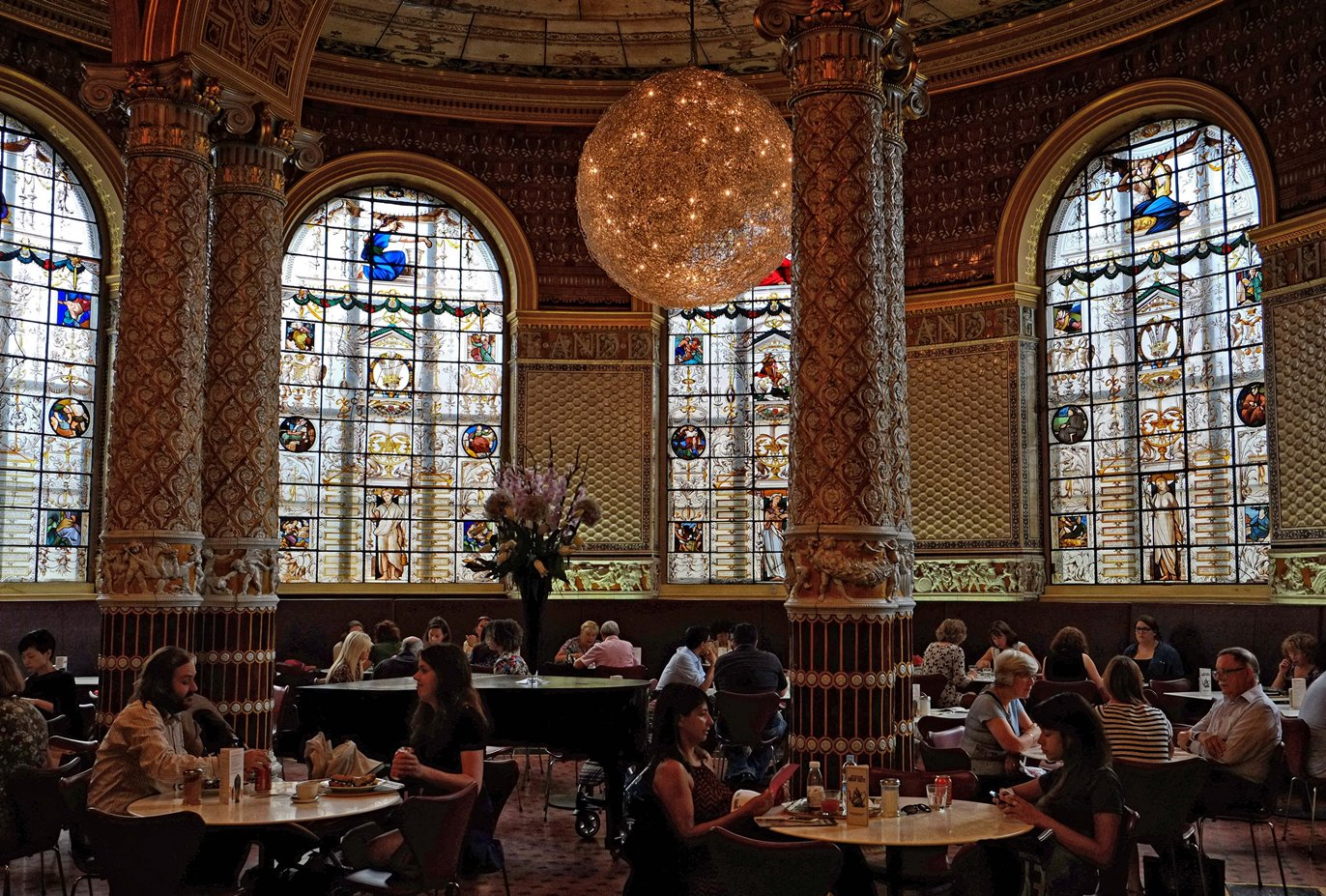
I am seventeen. In London again, we make a pilgrimage to the cafe in the Victoria & Albert Museum. Decorated by William Morris, this cafe has the best scones and clotted cream our family has ever tasted.

I am eighteen. I have just graduated from high school, and my grandparents borrow a pontoon boat for an afternoon on the lake. My cousin Hannah makes to-die-for strawberry-filled cupcakes. I'm not a cupcake person in generally, but my mouth still waters at the memory of these.

I am nineteen. It's floor night on the college dorm, and we pass around a pan of pizookie, taking ritual spoonfuls straight from the pan. Sure, it's cold season, but who is going to pass up just-barely-baked chocolate chip cookie with ice cream on top?

I am twenty. Mom and Dad graciously take me along to Charleston on their anniversary trip. We savor the best shrimp & grits in the history of Southern cooking.

I am twenty-one. I fill my semester abroad with oatcakes and cheese and scones and clotted cream on study dates with friends. Occasionally I splurge on a mouth-watering, artery-clogging full English breakfast - complete with beans and grilled tomatoes.

I am twenty-two. I fling my tiny college kitchen open to whoever wants to come - the freshman who is a kindred spirit, the surrogate grandparents who bring over veggies from their garden, the core group of friends who have walked through all four years of college by my side. We laugh and we cry and we grow and we learn from one another.

I am twenty-three, living in Munich after college. A girl from church - a fellow expat - has decided we are going to be friends. She invites me over for countless lunches of scrambled eggs and fried potatoes - comfort food. Over those countless lunches, we become fast friends.

I am twenty-four. Mom, Dad, Nana and I are in a tiny village clinging to a hill in Galilee - Zafed. There we have the freshest-you-could-possibly-imagine falafel, fingers chilly in the cold rain, bellies warmed by the freshly fried food.

I am twenty-five. On Tuesdays, my church Community Group has themed potlucks. Asian food, childhood favorites, vegetarian night, appetizer night. Each dish comes with a story that we share as we do life together.

I have a list of formative/memorable meals that spans five pages of a legal pad - and that was only the ones that sprang to mind effortlessly. There are so many more.

I have no idea how the rest of my life will pan out, but one thing I can confidently claim is that food - good food, shared with friends, family, and strangers - is going to always be a key part of my life.

Mom and Dad, thank you. Thank you for building our family around the table. Thank you for recognizing and cultivating the richness of experiences built around food. Thank you for giving me my love of good food and good conversation and safe and holy spaces. What a legacy.


P.S. Mom, as I write this, I'm listening to the French Kiss soundtrack. Nothing says "dinner music" like that album.

Wednesday, April 29, 2020

A Letter to Wheaton's Class of 2020

Wheaton is much on my heart these days. It's Wheaton Gives day - and I gave in honor of Julius Scott, a professor I never met but whose presence at Wheaton indelibly impacted my time there decades later. Several days ago, I got an email asking recent grads to send a note of encouragement for the class of 2020. I sat and typed this out on my phone with my whole heart. 


Dear Wheaton Senior,

The first time I cried during the pandemic was for you. I graduated just three years ago, and I grieve with you for the loss of your final quad at Wheaton.

But I have also rejoiced to see you responding with hope and resilience. The insta account @overheardatwheaton brings me so much joy. I’ve talked to some of you about the unexpected fruitfulness of online discussion forums, even in the midst of frustrations regarding zoom classes.

You didn’t leave Wheaton as you expected to. But you do leave prepared. You spent nearly four years at an institution dedicated to shaping you to go out into this broken world with great hope as you live for Christ and His Kingdom. I believe that even this unexpected end is for the purpose of preparing you to live with that call shaping your life.

Your dreams may be crumbling, or taking new forms. God has dreams for you, too, and the pandemic is no glitch in His plans. He is with you. He goes before you to guide you, behind you to protect you, beneath you to sustain you, and beside you to befriend you. Do not be afraid. The blessing of God is upon you. Although you are sad, do not be afraid. Go in peace - the peace that passes understanding, that is the shelter of those whose minds are fixed on the Lord, that is the gift you carry as you endure Coronavirus.

So stay strong as you finish up those zoom class sessions. Relearn your class song and sing it with gusto. Teach it to the family members you are quarantining with. Look through the years of photos and quotes from quote walls and send them to the friends you looked forward to celebrating your achievement with. Remember, and grieve, and laugh, and celebrate. During my last quad at Wheaton I found that laughter and tears are strangely suited to be beautiful companions. But even when it doesn’t feel beautiful - when it feels ugly and wrong and unfair - feel those emotions and bring them to the God who brought you to Wheaton in His own good time and has taken you from Wheaton according to His timing, not yours.

He meets you here - in online learning, in uncertainty for the future, in loose ends left untied - and He holds all of you with care and compassion and grace.

Be blessed, and know you are beloved.

Grace,
Kate 


Thursday, April 9, 2020

a journey through five years of Maundy Thursdays


Maundy Thursday 2016 - London, England

I slip into Westminster Abbey - late. Much too late to have a seat where I can see the celebrant and the speaker. I walk down the side of the ancient building - one of my favorite holy spaces in the world - and take a seat on a folding chair in Poets' Corner. 

A boys' choir sings through the service. Clergy kneel to wash twelve congregants' feet. I rejoice in my favorite line of the liturgy - "Lift up your hearts! We lift them to the Lord!"

Returning to my seat after receiving Eucharist, I step over the memorial flagstone for C.S. Lewis - "I believe in Christianity as I believe the sun has risen: not only because I see it, but because by it I see everything else."

Suddenly I am in awe. I feel the weight of glory - the cloud of witnesses. A statue of Handel - who wrote his Messiah oratorio in a bare three weeks - looks down on the scene. William Wilberforce sits in a tucked-away corner. According to the plaque beneath his statue, he added "to high and various talents, to warm benevolence and universal candour . . . the abiding eloquence of a Christian life." 

It is not just the witness of these great men that overwhelms me. It is the witness of the hundreds upon hundreds of faithful believers commemorated in this space. It is the witness of the thousands upon thousands who have worshipped in this space every Maundy Thursday for more than seven hundred years. It is the witness of the millions upon millions of Christians gathering today to remember - to remember Our Lord Who knelt with a basin and towel, Who broke His body and shed His blood to heal us, Who remained faithful when we were faithless, Who is the source of our unity and strength. 

Maundy Thursday 2017 - Wheaton, IL

It is the start of Holy Week services at Church of the Resurrection in Wheaton. I see my friend Karis across the sanctuary and slide into the pew beside her. During the time for the foot washing, she washes my feet so tenderly. I wash hers. 

We receive communion for the final time before the cross is shrouded. I will spend many hours in this space between now and Resurrection Sunday, but for all the many services, there will be no communion until the declaration of His resurrection is made. 

I don't know it yet - though I suppose I have an inkling - that those few days will be life-altering. 

Maundy Thursday 2018 - Großgmain, Austria

I live in Munich, and my college roommates Angela and Bryn are spending Easter weekend with me and my parents in a tiny town split by the Austria/Germany border. 

We read excerpts from T.S. Eliot's "Little Gidding:"

What we call the beginning is often the end
And to make and end is to make a beginning.
The end is where we start from. 

[. . .]
We die with the dying:
See, they depart, and we go with them.
We are born with the dead:
See, they return, and bring us with them.
The moment of the rose and the moment of the yew-tree
Are of equal duration. A people without history
Is not redeemed from time, for history is a pattern
Of timeless moments. 

[. . .]

With the drawing of this Love and the voice of this Calling

We shall not cease from exploration
And the end of all our exploring
Will be to arrive where we started
And know the place for the first time.
 

[. . .]

Not known, because not looked for
But heard, half-heard, in the stillness
Between two waves of the sea.
Quick now, here, now, always--
A condition of complete simplicity
(Costing not less than everything)
And all shall be well and
All manner of thing shall be well
When the tongues of flames are in-folded
Into the crowned knot of fire
And the fire and the rose are one.


Maundy Thursday 2019 - Winnweiler, Germany

I am working my way through the Ignatian Exercises, part of which involves imaginatively exploring the gospel accounts. 

In the evening, there is laughing and banter, good conversation and good food. Jesus is a little subdued, but we barely notice. It is a night for celebrating. Someone asks, "Why do we keep this feast every year?"

A shouted response: "To remember how the Lord God led our ancestors out of Egypt with a mighty hand and outstretched arm and brought them to the Promised Land."

Simon the Zealot asks Jesus: "Lord, is the time soon coming when You will restore the Kingdom to Israel?"

There is a lull in the conversation - people waiting for Jesus' answer. My heart beats faster.

But Jesus seems not to have heard the question. He rises and leaves the room. 

There is a confused pause. The conversation slowly picks up again, people asking one another why He is in such a strange mood.

I notice Him come back in, a towel wrapped around His waist. He fills a basin with water, kneels down behind John, and starts washing his feet. John starts, but says nothing, going quiet and trying to take it in. I glance around the table. Most people haven't noticed anything amiss - conversation continues.

Jesus dries John's feet and moves to Peter. Peter startles violently at Jesus' touch, clattering against crockery and bringing all conversation to a halt. Jesus smiles and reaches again for Peter's foot. Peter pulls away.

"Lord! Do you wash my feet??"

Jesus sits back on the balls of His feet and looks at Peter. "What I am doing you do not understand now, but afterward you will understand."

"You shall never wash my feet!"

Jesus continues to gaze at Peter. "If I do not wash you, you have no share with Me."

Peter looks at Jesus, stupefied, jaw dropped. He does not resist again, but looks on in a daze. He has seen those hands heal the sick, multiply loaves, cast merchants from the temple, calm a storm. And now those hands are washing his filthy, callused feet.

As Jesus begins drying his feet, Peter blurts out: "Lord, not only my feet but also my hands and my head!"

Jesus smiles - oh, impetuous Peter. "The one who has bathed does not need to wash, except for his feet, but is completely clean. And you are clean, but not every one of you."

He moves on to Andrew.

I am next.

I look at Him as He began to wash my feet, hands tender and firm. The water is cool and refreshing after a long day of preparing and no time to sit down. I don't understand, but I feel His love and care - and also sorrow.

"Lord," I ask, "Who is going to wash Your feet?"

He looks at my face, but gives no answer.

After He finishes washing everyone's feet, He goes back to His seat. "Do you understand what I have done to you? You call me Teacher and Lord, and you are right, for so I am. If I then, your Lord and Teacher, have washed your feet, you also ought to wash one another's feet. For I have given you an example, that you also should do just as I have done to you. Truly, truly, I say to you, a servant is not greater than his master, nor is a messenger greater than the one who sent him. If you know these things, blessed are you if you do them."

I have been debating ever since it was my turn. Now I decide. As Jesus speaks, I get up as quietly as I can. I wrap the discarded towel around my waist, take up the basin, and kneel down behind Jesus. I take a deep breath, then I gently take His feet and start pouring water over them, spongeing them off. He turns toward me, and I am startled to see tears in His eyes. My own brim. 

Maundy Thursday 2020 - Montreat, NC - Church of the Resurrection, Wheaton, IL

Tonight I am in the guest room at my grandparents' house in Montreat, North Carolina. For the first time in three years, I join the Church of the Resurrection Maundy Thursday service - one silver lining of a pandemic is that I am able to worship with the Rez community even though I'm hundreds of miles away.

The service is bittersweet - as the bishop asked, "Who would have imagined a Maundy Thursday in which we cannot gather around the Table?"

And yet, I am reminded of the clouds of witnesses I felt so overwhelmingly four years ago in Westminster Abbey. I may be alone in this bedroom, but I am joining in community with over 400 people tuning in to this livestream, and with hundreds of thousands who are celebrating Maundy Thursday from the shelter of their own homes.

The longing for kingdom community is real - and it is a reminder that even we can gather together in churches, we are still waiting for the time when all things are made new and we feast at the wedding supper of the Lamb - with Jesus in His Kingdom.

But for now I ponder the words of the sermon-

He gives us provision in the wilderness.

He places us in a family.

He prepares for us a feast.

He plans for us a future. 

Jesus' suffering on the cross is so that His Father can be our Father. He places us in His family with His Father, because He knows the wildernesses we will walk through, and He gives us one another to wash each other's feet and love one another to the end. 

He gives us Himself. 

This is Jesus' Story. This is why He came. Jesus longs for the fulfillment of the Passover Feast in the Kingdom of God. 

He waits for us and He waits with us. 

"Let not your hearts be troubled. Believe in God; believe also in Me. In My Father's house are many rooms. . . And if I go and prepare a place for you, I will come again and will take you to myself, that where I am you may be also . . .Peace I leave with you; My peace I give to you. Not as the world gives do I give to you. Let not your hearts be troubled, neither let them be afraid. . .This is my commandment, that you love one another as I have loved you. . . .I have said these things to you, that in Me you may have peace. In the world you will have trouble. But take heart; I have overcome the world" (John 14:1, 3, 27; 15:12; 16:33). 

We rehearse the story of Jesus, Who has overcome. 

Though we are quarantined, the Power of Jesus is not. The Holy Spirit is not on lockdown. We shelter at home, but we shelter under the wings of Jesus. 

We have been shaken, but we hold fast to a kingdom that is unshakeable.

***

Every night for three weeks I have read a poem on my instagram stories. Tonight's poem is "Judas, Peter," by Lucy Shaw.

because we are all
betrayers, taking
silver and eating
body and blood and asking
(guilty) is it I and hearing
him say yes
it would be simple for us all
to rush out
and hang ourselves
but if we find grace
to cry and wait
after the voice of morning
has crowed in our ears
clearly enough
to break our hearts
he will be there
to ask us each again
do you love me?

Saturday, April 4, 2020

unexpected fellowship

Online church is not my thing.

Which is something I need to work on, since online church is the modus operandi for churches worldwide these days.

Maybe tomorrow I'll gear myself up and attend an online Palm Sunday service. But to be honest, the last few weeks, I haven't even tried. Don't get me wrong; in many ways I'm more connected to my spiritual community right now than I was before a global pandemic kept us all at home - praise the Lord for technology. But that doesn't mean I'm watching the weekly sermons.

Strange how the Lord provides even when I don't feel like showing up.

Last Sunday, my grandparents' previous pastor and his wife, whom I have known my whole life and absolutely adore, appeared on the front porch with a guitar and a pie. They came around back and announced that they were there for a 10-minute church service - and they meant a full-blown church service, complete with prayer, sermon, hymns, offertory (the pie), special music, and benediction.

They are absolutely amazing.

We all kept our distance (probably the hardest thing so far - I dearly wanted to hug these precious friends) and reveled in the fellowship.

The sermon, well, it was something else.

After a couple of songs, Owen directed us to open our Bibles to John 11:35. We chuckled as we all leafed through imaginary Bibles, until he "arrived" at the text:

Jesus wept. 

"As we examine this text together, it occurs to me to wonder why Jesus wept. Yes, Lazarus was dead, but Jesus knew that before long, He would raise His friend from the dead. So why did he weep?

James Tissot / Public domain
"There are many theological reasons that people have proposed, but there are two that I want to focus on today. For the first, please turn with me to Isaiah 53:3 (more imaginary leafing): 'He was a man of sorrows and acquainted with grief.'

"The first reason that Jesus wept is that He knew the pain of sorrow and grief. He knew the hearts of Mary and Martha in their grief and confusion, and He sorrowed for their sorrow, even though He knew that the cause of their weeping would soon turn to joy. He weeps with those who weep.

"Now, as I said, there are many theological reasons why Jesus wept, but it strikes me in this time that one of those reasons was that He simply missed His friend" - Owen choked up - "just like we miss you, precious friends."

Wow. What a sermon for this time. Jesus wept. He knew what it was to sorrow with devastated friends - friends who were at least partly devastated because they knew He could have stopped the death, had He so chosen. He did not stand back callously and refuse to share their sorrow, knowing that it was temporary. He entered into their grief with them, because even though He knew the ultimate story would be one of resurrection, this part of it hurt like hell. Because death must precede resurrection.

He also knew what it was to miss dear friends - to face the pain of separation on earth. And He wept for it.

I've been talking to my students about two things as we prepare to enter into Holy Week during a pandemic. First, God is in control. He is not surprised. He is not overwhelmed. He holds each of us in His hand and guides our steps. He will work out all things for the good of those who love Him and who are called according to His purpose.

Second, He is not removed from us in sorrow and confusion and pain. He steps into those emotions with us, even though He knows the bigger picture. He is not impersonal - He is deeply personal and caring.

That precious ten minutes on the back patio on a Sunday afternoon will be one of the sweetest memories from this time - sweet for the unexpected fellowship with longtime friends, and sweet for the reminder that God fellowships with us.

Grace be with you. 

Wednesday, February 26, 2020

An Ash Wednesday Meditation

Remember that you are dust. To dust you shall return.

On the top floor of the Billy Graham Center in Wheaton, there is a nearly life-sized crucifix. As crucifixes go, it's fairly typical. Jesus' arms are opened wide, nailed to the cross. His head hangs under the crown of thorns and the weight of sin.

It's not the form of the crucifix that's unusual; it's the substance. This crucifix is made of dust. Literally.

The sculptor - whose name I cannot remember, which is why I have no image to share with you - collected the contents of the campus vacuum cleaners for months upon months. Then, he compressed the dirt and dust and used it as his medium to craft a crucifix.

It seems sacrilegious, almost, until you remember: we humans are formed of dust.

In the moment of the Incarnation, God Himself became human - He humbled Himself and took on the form of man - made of dust.

Remember that you are dust. To dust you shall return.

I found myself contemplating the memory of that crucifix during the Ash Wednesday service that I attended this evening. Believers throughout the world gather on Ash Wednesday to mark the beginning of Lent - a season of fasting and repentance as a time of preparation for Easter.

In a dimmed sanctuary, the members of the congregation silently stepped to the front to receive the ashes. The priest dipped his finger in a mixture of ashes and anointing oil and imposed the sign of the cross on each congregant's forehead. He spoke softly: "Remember that you are dust. To dust you shall return." Somehow, in a quirk of acoustics, all that was audible unless you were the one receiving the ashes was "dust...dust...return...dust...dust...return...dust...dust...return." 

In the ten minutes of silent listening to this refrain, I contemplated the anointing. That cross on our foreheads is an mystery and a reminder: we are dust; Christ became dust for us; though once we were sinners under judgment we are now covered by the work of the Messiah on the cross. We are marked by His grace.

Because He became dust, our return to dust is not the end of the story. When we return to Him, He begins the mysterious work of renewal in us that will be completed when He comes again.

Remember that you are dust. To dust you shall return.

This refrain stems from the curse in Genesis 3, when God pronounces judgment on Adam for his rebellion against the Lord. In other contexts, the word refers to ashes; hence, Ash Wednesday. 

But there is another Hebrew word used earlier in Genesis 2 in the account of man's creation. It's actually the word that the name Adam comes from, and it means land, ground, or soil. It is from this idea that the layperson, Mary, who delivered the homily this evening, developed her question:

How is the soil of your soul?

Mary went on to paint an image of Lent that I wasn't familiar with: a time for tilling the soil of our souls, so that we are ready to receive the seed of joy that Easter brings. 

It's a beautiful image, made more beautiful by a story she told. 

Early in her marriage, she and her husband were directors of a community called Selah out in California. The community shared apartments around a courtyard. Initially, the courtyard was barren, with dead bushes and some scraggly plants - not a welcoming place. But the members of the community decided that they wanted it to be a gathering place, so they went to work - weeding, preparing the soil, planting seeds. It became a beautiful garden. 

One day Mary came down the stairs with a load of laundry to find a sweet Japanese lady on her knees in the garden. She had a plastic sieve, and she was carefully shaking the dirt through it. As she sifted, she threw out rocks, twigs, and pieces of trash. 

When Mary asked what she was doing, her friend replied, "If I don't do this, the soil won't be any good."

If I don't do this, the soil won't be any good. 

What an image for the discipline of Lent - a time to sit with the Lord and sift the soil of our souls, opening up to His work in our hearts to sift out rocks and twigs and trash so that we can bear the fruit of abiding in Him. 

Remember that you are dust. To dust you shall return.

As I sit on the couch in my PJs, preparing for rest, these images are settling in my heart. 

The sibilant refrain "dust...dust...return...dust...dust...return."

The sensation of ash and oil on my forehead. 

The image of a woman kneeling in the dirt to sift the soil so that living things could grow in it. 

The image of a Jesus made of dust stretching out His arms on the cross. 

Remember that you are dust. To dust you shall return.

We are dust - but thanks to the work of the Creator and Redeemer, we are anointed dust. Consecrated to carry out His work and bear the fruit of abiding in Him as we walk through the brokenness and beauty of this fleeting life. As we dwell on this turning world, may we continually return to Him. 

Wednesday, October 10, 2018

the ministry of showing up


On Friday evenings I co-lead a church youth group.

Those who know me well will recognize the irony of this fact.

I never attended youth group. (Actually, I think I did for a brief season, but I expunged the experience from my memory.) I always preferred joining my parents for their Bible studies.

Even as a teenager, I had very little idea how to interact with your average teenager. Give me a book or a grown-up. Or a soccer ball so we can play a hard game of soccer and not bother with awkward small talk.

So when I joined the team that leads the youth group, I had no idea what I was getting into. Literally: the group for 20-somethings I attend is called Jugend (youth), and the group I co-lead is called TeenKreis (teen circle). So it did not once occur to me that I was volunteering to lead a youth group until I walked into our first meeting. Yes, I can be painfully oblivious.

I did a quick survey of the room, realizing that there were around fifteen kids between the ages of 13 and 17. Lounging on couches, talking in cliques, the girls with braces and the boys with changing voices.

Oh my gosh. This is youth group.

Not gonna lie, I had a moment of wanting to turn around and walk right out the door.

But I was there as a leader, so I made conversation. At which point I realized Challenge Number 2: this is a German group. So I'm supposed to engage with and teach teenagers - a group I've never been able to relate with - in a foreign language. Super.

I went home that night and poured out my frustration to God.

"Why am I doing this? What have I gotten myself into? I don't know how to relate to these kids! Even if we were interacting in English I would have no idea what to say to them. And we're speaking German, for crying out loud! It's all I can do to keep up with the conversation, and then I'm supposed to say something meaningful and be some sort of role model? This is not what I signed up for. Ok, maybe it's what I signed up for, but I wasn't aware of it, and that's almost worse."

And He quietly answered, "Kate. They don't need you to relate to them. They need you to love them."

Oh.

Ok then.

There's really no other answer to that.

So on Fridays, I show up, struggle through conversations, and pray that these teens will experience some small taste of the love of God through my presence, even when I have no idea what I'm doing. When I run into them in church on Sundays, we make small talk. With lots of awkward pauses. This Friday night, I'm in charge of the devotional: 45 minutes to talk about plagues. (We're working through the book of Exodus.) I'm looking up all the terms I think will be important, trying to come up with meaningful discussion questions, working to anticipate their questions, and praying for the grace to handle the inevitable language mix-ups with poise and humor.

Mostly I'm praying that they will know the God who showed His power with a mighty hand and outstretched arm over Egypt. Praying that they will know His love and power and presence. That they will be amazed by Him.

*

I feel like there should be some sort of clear point to this, but I'm not quite there yet. The closest I can come is this: Something that the Lord has shown me recently is that often I'm not supposed to know what's going on. I'm just to faithfully be present and expect Him to work.

I've started calling it "the ministry of showing up."

So that's what I'm doing: showing up with my meager offering and expecting Him to be faithful in serving His children.

I have a feeling I'll probably be writing more about this "ministry of showing up" in the next few months, since it's a part of many areas of my life, not just youth group.

Where is God calling you to show up and be present?

Monday, May 7, 2018

Mama's wisdom | bloom where you're planted


Long before the boxes are unpacked, my mom puts a magnet on the fridge.

“Bloom where you’re planted.”

In a life of constant transition, frequently uprooting from a now-familiar place to move once again to new cities, states, and even countries, it’s a blessed and much-needed reminder.

Over the years the phrase sinks into my bones.

I add my own to it: an index card with a Jim Elliot quote in blue letters:

“Wherever you are, be all there.”

Over the years, I build up a collection of quotes, Bible verses, fragments of sayings circling the idea of being present, making a home, putting down roots while knowing another change is just around the corner. Clinging to a heavenly home while making a haven of each place of sojourning.

There are two ways to handle the constant moving.

One is to remain distant, getting by on superficial relationships and minimal involvement. You avoid making ties to people and places in order to minimize the pain of parting. Don’t nest, because soon enough you’re going to have to pack it all up again.

The other option is to choose to put down roots. It’s a deliberate choice, made because you know the richness and joy of a life rooted in a particular place and a particular community. But you count the cost every transition. Uprooting is exhausting, and you leave a part of your heart behind you. Every. Single. Time.


I’m a roots person.

As I ran through a park in Munich today, reveling in the uncontainable outburst of spring, I realized why.

A plant can’t bloom if it doesn’t have roots.

I have to put down roots, however temporarily, or part of me will wither. I would much rather have a rich life with bittersweet partings than close myself off from pain and joy alike.


This is a common theme for me, and it’s at the forefront of my thoughts right now.

It’s not just the visible presence of spring and new growth that has me pondering transient rootedness.

A year ago today, I graduated from college. That particular uprooting was agony.

Now I’m waiting to hear if I get to stay in Munich for another year or if something else is in store.

When I moved here eight months ago, I assumed I’d be here just shy of a year. Even so, I became a member of a church, joined a choir, hung pictures on my wall. I made the space a spiritual and physical home, not simply a place to spend the night.


During the times when I got restless and lonely and frustrated with the challenges of being in a new job in a new city in a foreign country, I challenged myself be more present here instead of withdrawing and hunkering down until my time was done.

Now I have two possibilities: stay another year and continue to deepen the roots I have here or transplant again come July.

Whether now or later, inevitably I will pack up and leave Munich. I’ll move to another place. And one of the first things I do there will be to unpack my own reminders. Reminders to bloom where I’m planted, to be all there in spite of – and because of – the knowledge that eventually I’ll move on again.


Friday, April 13, 2018

Germany | the weird and the wonderful


I had my first ever houseguests this month!

Of course, I helped my mom host guests throughout my childhood, and several friends visited while I was in college. But this was different: my dear friends Bryn and Angela flew ACROSS THE ATLANTIC to come spend a week with me.

We rode on countless trains, hiked in the alps, enjoyed world-class art museums. In the evenings we played bananagrams, danced, and talked endlessly about faith and post-college life and books and ideas. (And we introduced Bryn to Lizzy Bennet Diaries.)

It was pure joy to have them.

Something I really enjoyed was hearing their impressions of Germany. I've lived here so long that I'm accustomed to most quirks of the place and don't notice them anymore.

As Bryn and Angela commented on things that they found amusing, confusing, and wonderful about Germany, I kept a running list on my phone. Here are some of them.

Water fountains are not a thing in Germany. I don’t know why this is, but I have never seen a water fountain here. It used to be that most tap water in public bathrooms was not potable, so if you wanted water you had to buy it. Now you can usually fill up at a bathroom sink.

But to get into that bathroom you probably had to pay. A 50 cent charge is typical to use a public bathroom, which makes complete sense to me. I’d much rather pay to use a clean bathroom than be grossed out for free. But it's also a bummer when you desperately need to use a bathroom and don't have any change on you.

Speaking of things you have to pay for, you can't order free tap water at restaurants. Beer is often literally cheaper than water.

Stoplights here turn yellow before they turn green.

Roads are very narrow. That said, sidewalks are very wide. Bryn commented that the sidewalks are so wide she would have thought they were driving lanes. This is a perfect example of how much Germans value walking, biking, or taking public transit above driving. 

You can’t pay at the pump at German gas stations. I have no idea why.

There are no billboards along the roads. (Well done, Germany!) 

The color palate is brighter. It's common to see buildings painted in bright, bold colors.

Mailmen ride bikes, not vans. And they contribute to the bright color palate: they have yellow bikes, jackets, and mailbags.

There are lots and lots of flower shops, and they are usually not connected to grocery stores like they are in the States.

Mistletoe grows in huge clumps on trees

When German families move, they take their kitchens with them. Cupboards, sink, counters, dishwasher, fridge and freezer - it all comes out of the old place and into the new. So it's not uncommon that when you look at a German home for rent or sale, the kitchen area will be a gutted room with connections to plumbing but no actual kitchen. 

German homes do not have built-in closets. People keep their clothing in dressers and wardrobes. My parents explained to us that this is because closets are taxed like rooms. So homes are more affordable if they do not include closets. Go figure.

Woodpiles are standard. A lot of German homes still have wood-burning stoves (of course, they also have modern heating and cooking, just to be clear), and they have a lot of wood stacked up to feed those stoves.


Of course, this is only a handful of the things that stick out to a newcomer in Germany. If you're curious about more, or if you're familiar with Germany and want a good laugh, check out this Buzzfeed article. (Heads up for some vulgar language.)


Tuesday, August 22, 2017

sometimes it's the smallest things - springboards to friendship

Immediately after the congregation was dismissed, Mama leaned over and whispered, "I love that lady's haircut!!!"

Two things that are high on our list of things to find when we move: a church home and a hairdresser. We were close to settling on a church home, and Mama never hesitates to ask strangers where they get their hair cut.

As I gathered my sundries, Mom bolted out of the pew to catch the lady with the fabulous hair. By the time I got to them, they were deep in a conversation about hairstyling woes and fixes. Shortly thereafter, the conversation moved on as they swapped stories about how each ended up in Germany.

Before I knew it, we had accepted an invitation to lunch at an Asian restaurant. Jennifer and Mama had hit it off, and they wanted to continue their conversation. (Dad was at a conference that weekend.)

On the way out, Jennifer introduced us to another lady who is clearly the instigator of a lot of church projects. Her first question to Mama: "Do you run?"

It turns out that she's trying to organize a fun run to raise awareness for Compassion International. She's not a runner though, and wants insights on how these things go. My family has never organized a fun run, but we have participated in plenty, so before names had been exchanged we were in a pow-wow about how to organize a family 5k.

And just like that, we had two new friends and an "in" into this church community. All because my mom wanted to find out where a stranger gets her hair cut.

The moral of the story: if you want to make a friend, compliment their hair and ask where they get it done.

But actually.

Sometimes all it takes to make a friend is to compliment them on something they have a vested interest in and then ask them more about it. My mom cuts my hair, so I don't actually ask people about their recommended hair salon. But I've used the idea multiple times with people I want to get to know - I ask them about a project they've worked on that I appreciated, or a book they're reading that I love, and then I use that as a springboard to a conversation. Sometimes it's a two-minute conversation and nothing more comes of it. But sometimes we hit it off and I actually gain a friend from taking the trouble to reach out.

As I prep to move to a new city by myself, I'm keeping this maxim in mind to make me smile and give me the necessary kick in the pants to meet people instead of staying in my nice little comfort zone:

Make a new friend: ask where they get their hair cut. 

Tuesday, June 7, 2016

standing on the promises


I got to spend last weekend in Charlottesville with some of my favorite people in the world - the crazy awesome Morales family who we've been friends with for thirteen years. The weekend was jam-packed - we celebrated Maddie's 20th birthday and got to watch Josh's soccer games and just hang out together. At night we watched the mountain behind their house light up with thousands of fireflies as a thunderstorm rolled in.


One of my favorite moments of the weekend was Sunday morning when we gathered for a time of worship after breakfast.

Mr. Morales read a few verses, one of which was Hebrews 6:11-12, "And we desire each one of you to show the same earnestness to have the full assurance of hope until the end, so that you may not be sluggish, but imitators of those who through faith and patience inherit the promises."

Then he asked: "What are the promises?"

Each one of us - thirteen people ages 6 to 50 - named one of the promises of God.

"For where two or three are gathered in my name, there am I among them." Matthew 18:20

"And He will command His angels concerning you, to guard you in all your ways." Psalm 91:11

"The steadfast love of the LORD never ceases; His mercies never come to an end; they are new every morning; great is Your faithfulness." Lamentations 3:23-24

"With God we will gain the victory, and He will trample down our enemies." Psalm 60:12

He has promised the crown of eternal life to those who love Him. (James 1:12)

The Bible is full of promises from God to His people. In fact, the Christian faith centers around the fulfillment of the promises of God - the central one being the promise of eternal life.

Search the Scriptures - or just put "promise" into a Bible search engine - and you will find that God makes spectacular promises. And His promises are true.

"For no matter how many promises God has made, they are "Yes" in Christ." 2 Corinthians 1:20.

I started thinking about some of the promises of God that I return to over and over.

Thinking about the promise of eternal life reminded me of one of my favorite verses in Scripture.

"And this is eternal life: that they know You, the only true God, and Jesus Christ, whom You have sent." John 17:3 

The promise of eternal life is the promise that we can know God intimately. It is closely connected with the promise that Jesus makes to us that "Never will I leave you, never will I forsake You" and "Behold, I am with you always, even to the end of the age" (Hebrews 13:5, Matthew 28:20). Because of these promises, I am confident that in every moment of life Jesus is with me. He is, after Emmanuel - God with us. This is no small thing - that the Lord of the universe who conquered death and crushed the powers of hell promises that He is with me always and that He will fill me with the power of the Holy Spirit - the same power that raised Jesus from the dead (Romans 8:11). As if that promise were not enough, I know that He will fill me with joy in His presence now and that ultimately I will find eternal pleasure at His right hand (Psalm 16:11). As I walk in His presence and in obedience to Him, He will satisfy my soul (Psalm 63:5).

Jesus does not promise an easy life. In fact, He promises that the world will hate those who love Him - just as they hated Him (John 15:18). But He does promise that He is with us through good times and bad and that all our troubles in this life will be like nothing compared to the weight of glory that will greet us in heaven (2 Corinthians 4:17).

"In this world you will have trouble. But take heart! I have overcome the world." John 16:33

These are powerful promises, ones to internalize and mull over and cling to and use as a cause for worship and great rejoicing.

What are the promises that you live by? Comment below: I'd love to hear!

{via Pinterest}

"Jesus Christ is the same yesterday and today and forever." Hebrews 13:8

"Come to Me, all you who are weary and burdened, and I will give you rest." Matthew 11:28

"You will seek Me and find Me when you seek Me with all your heart." Jeremiah 29:13

When I doubt, He will not forsake me, for it is promised that "if we are faithless, He remains faithful - for He cannot deny Himself" (2 Timothy 2:13).

"No temptation has seized you except what is common to man. And God is faithful - He will not let you be tempted beyond what you can bear." 1 Corinthians 10:13

"He who began a good work in you will carry it on to completion until the day of Christ Jesus." Philippians 1:6

"Have I not commanded you - Be strong and courageous. Do not be afraid; do not be discouraged, for the Lord your God will be with you wherever you go." Joshua 1:9

"The grass withers and flowers fade. But the word of the Lord stands forever." Isaiah 40:8